 Domain SearchInstantly check and register your preferred domain name
 Web Hosting
 cPanel HostingHosting powered by cPanel (Most user friendly)
 WordPress HostingHost your WordPress website with fast, secure, and affordable WordPress hosting in Kenya.
 KE Domains
 Reseller HostingStart your own hosting business without tech hustles
 Windows HostingOptimized for Windows-based applications and sites.
 Free Domain
 Affiliate ProgramEarn commissions by referring customers to our platforms
 Free HostingTest our SSD Hosting for free, for life (1GB storage)
 Domain TransferMove your domain to us with zero downtime and full control
 All DomainsBrowse and register domain extensions from around the world
 .Com Domain
 WhoisLook up domain ownership, expiry dates, and registrar information
 VPS Hosting
 Managed VPSNon techy? Opt for fully managed VPS server
 Dedicated ServersEnjoy unmatched power and control with your own physical server.
 Website Builder
 Online Store BuilderLaunch a professional e-commerce store without writing code.
 Web Design ServiceGet a custom-designed website tailored to your brand and goals. From just KES 15,600
 BlogRead our guides on web hosting, online business, digital marketing, and more
 SupportOur support guides cover everything you need to know about our services
 ContactContact us via chat or email
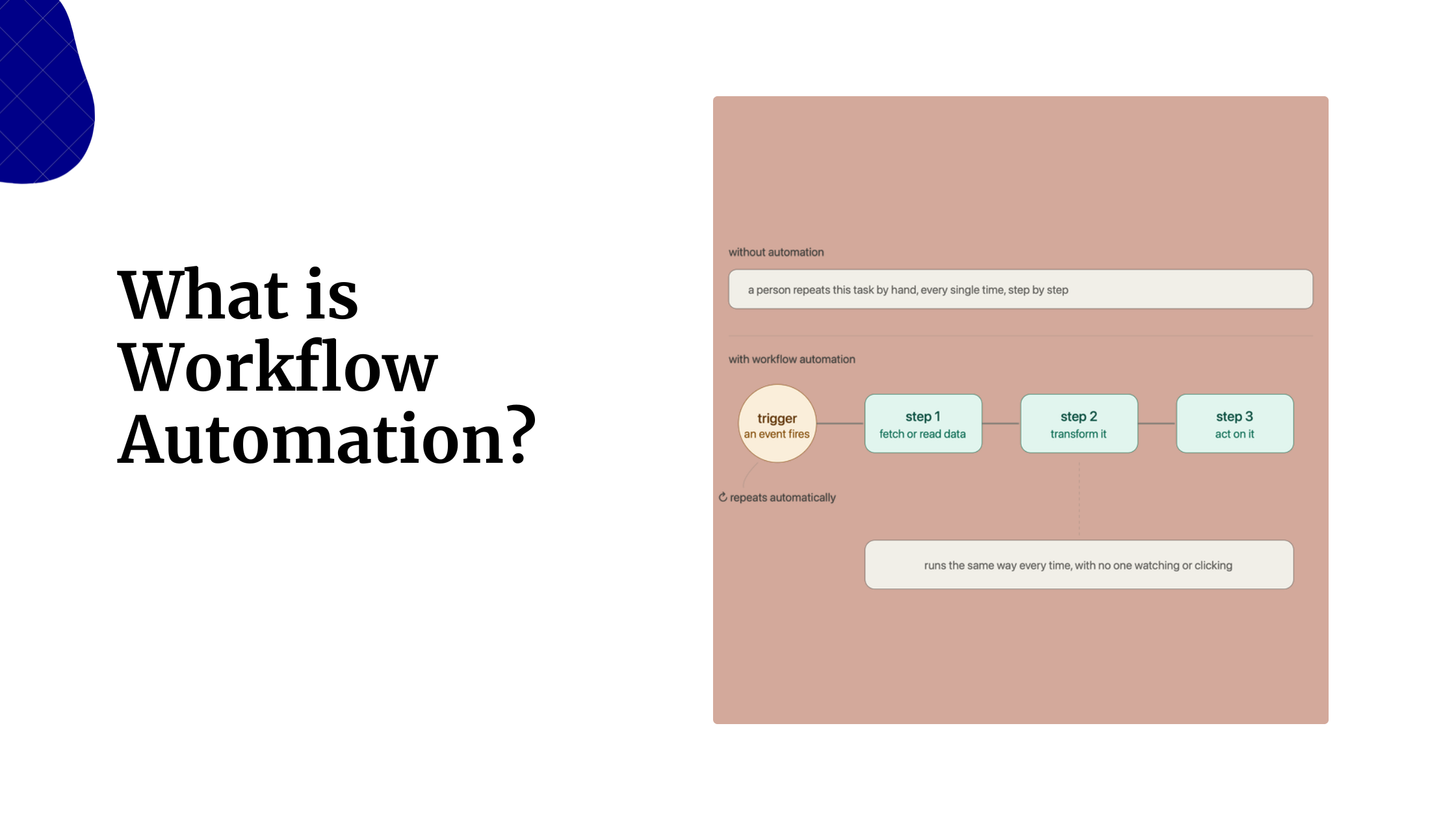
You know how intense it feels when you’re copying data between spreadsheets, sending the same follow-up emails, or doing the same digital tasks over and over?
That’s what workflow automation solves.
Research shows that over 40% of workers spend at least a quarter of their week on manual, repetitive work.
Automation platforms like n8n connect your apps and handle those tedious jobs.
N8n is an open-source tool that gives you the power to customize. Unlike many alternatives, you can host it on your own infrastructure.
It uses a visual editor where you connect nodes representing apps or actions, and you can add conditional logic and custom APIs.
But n8n isn’t perfect.
This is perfecto
It needs technical know-how; you’ll need to understand APIs, data structures, and sometimes JavaScript.
Hosting it yourself means dealing with servers and security updates. Also, complex workflows can cause performance issues.
For many teams, these drawbacks make n8n a tough sell.
Do You Really Need Workflow Automation Alternatives?
If you’re a developer comfortable managing infrastructure and need deep customization, n8n might be exactly what you’re looking for.
The free, self-hosted version gives you unlimited workflows with no per-operation fees.
But if any of these apply to you, consider some alternatives:
You have no dedicated DevOps team: Self-hosting n8n means handling updates, performance, security, and backups yourself.
You need advanced AI capabilities: n8n’s stateless design limits it to simple decisions. For autonomous agents that learn, you need a dedicated AI platform.
For non-technical team members: Marketers and ops staff struggle with n8n’s technical interface and setup.
Enterprise governance required: Cloud versions offer basic RBAC, but compliance certifications like SOC 2 are your responsibility when self-hosting.
Rapid scaling: n8n’s single-threaded model creates bottlenecks as workflows grow more complex.
8 Alternatives to Consider and What They Are Doing Right
Before we get into details, let’s have a glance at the alternatives:
1) xpander.ai
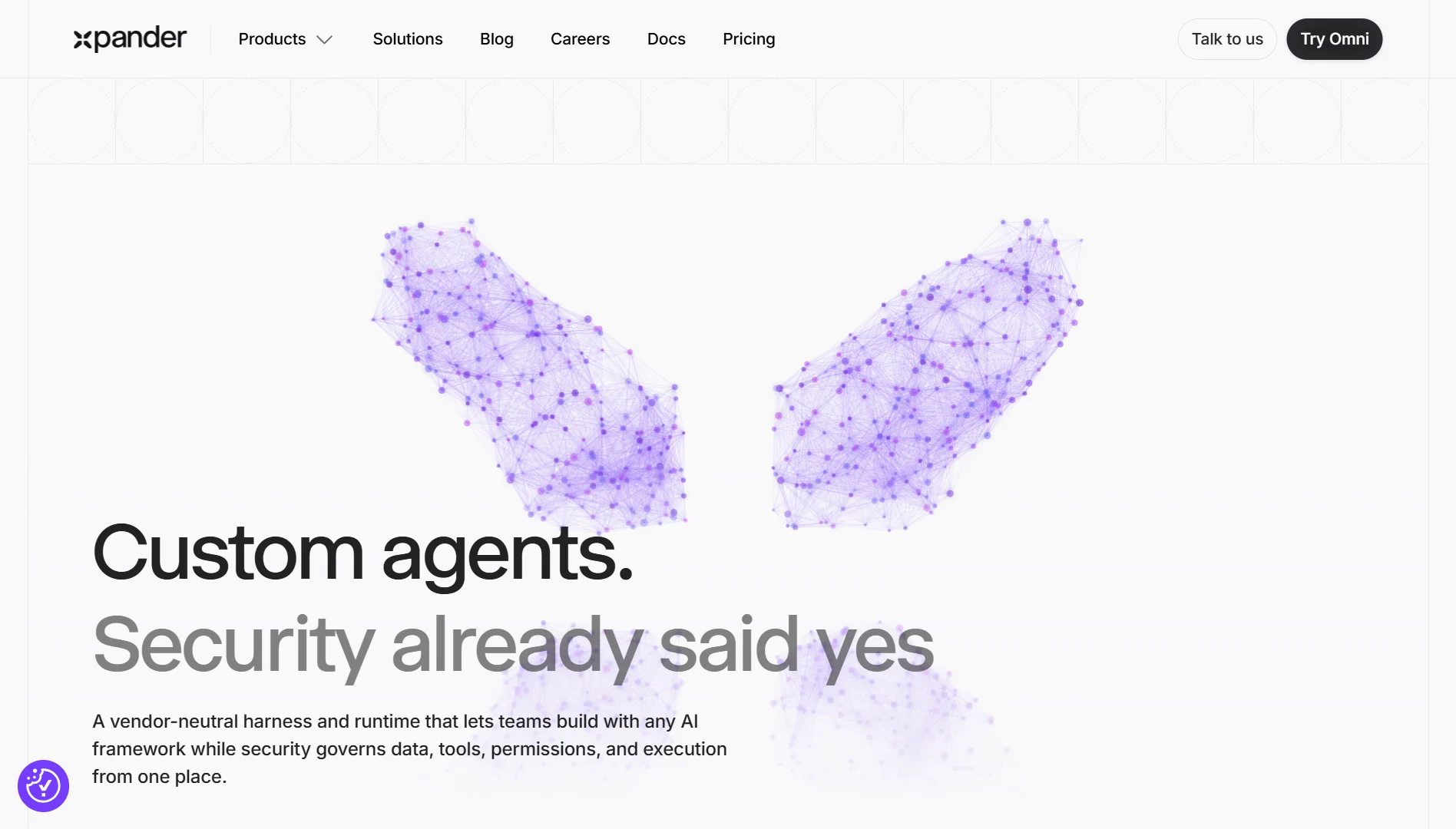
xpander.ai takes a different approach from n8n. Rather than being a workflow automation tool with AI features bolted on, xpander is built as an enterprise AI agent platform from the ground up.
What makes xpander stand out is its vendor-neutral design.
It works with any AI framework or LLM provider and can be deployed anywhere, including air-gapped VPCs and on-premises environments with your own GPUs.
The platform includes a generalist AI agent, Omni, that runs in a secure workspace and connects to Slack, Telegram, WhatsApp, and other interfaces.
It scored 87.3% on the GAIA benchmark, which is a significant achievement for complex tasks spanning multiple systems.
For n8n users who struggle with memory management and autonomous decision-making, xpander offers persistent memory across sessions, multi-agent orchestration, and built-in vector database support for RAG.
The self-hosted option starts at $6,300/month for 50 users, builders, and agents.
It beats n8n in enterprise governance, persistent memory, vendor neutrality, and true autonomous agent capabilities.
2) Zapier
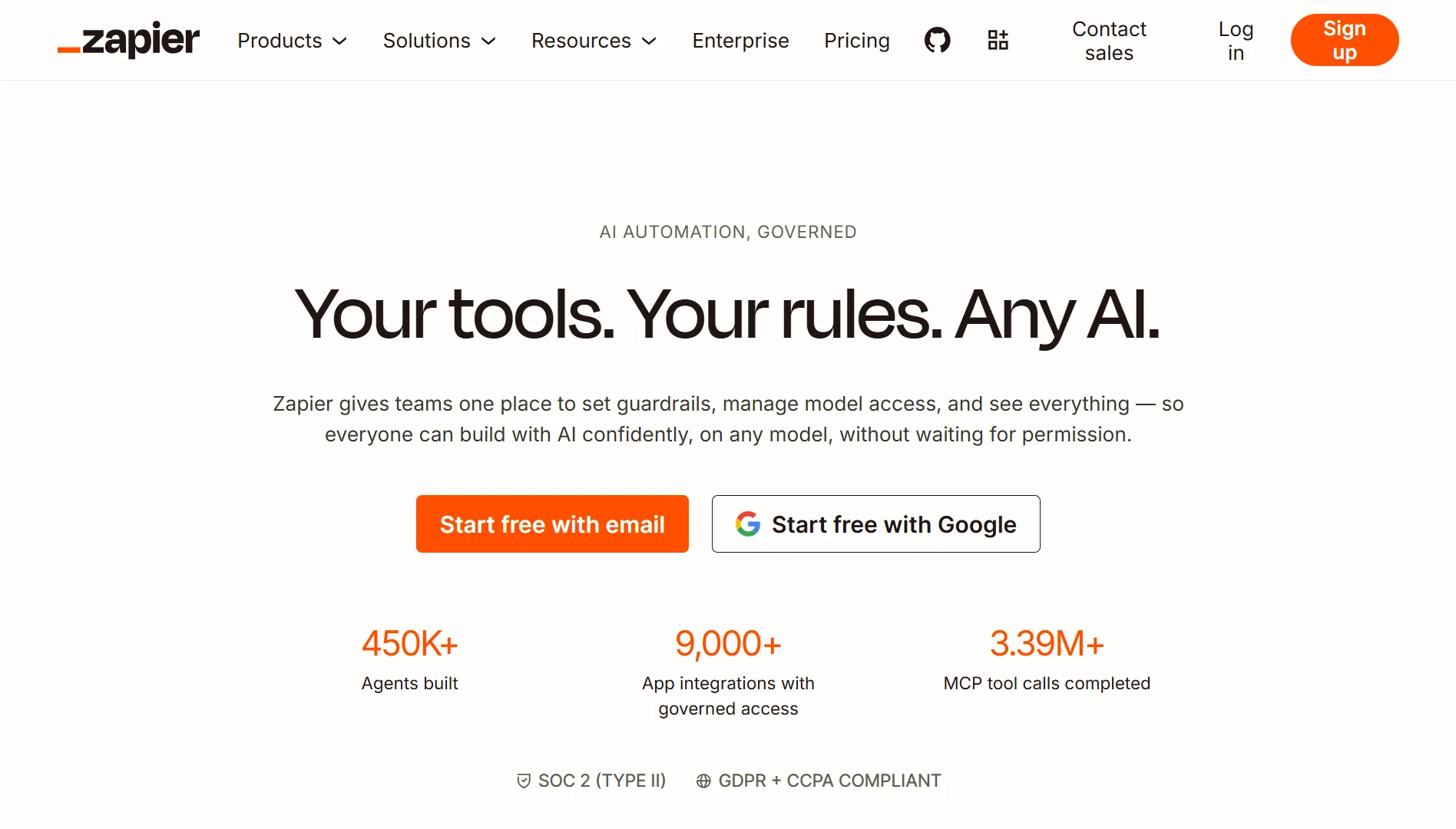
Zapier a popular automation for good reason. It focuses on making automation accessible to non-technical users through a guided, step-by-step interface that anyone can figure out.
Zapier supports over 6,000 app integrations. This is by far the largest library in the space, meaning you’re less likely to need custom connectors.
It also recently added MCP support, allowing AI assistants like Claude and ChatGPT to connect directly to thousands of apps through governed connections.
The governance features are particularly impressive for enterprise users.
Action Restrictions let you control which operations teams can perform within approved apps.
For example, allowing reads from HubSpot while blocking creates and updates.
Bring Your Own Model (BYOM) lets you route AI processing through your own AWS Bedrock account, keeping encryption keys and compliance certifications under your control.
AI Guardrails can detect PII, prompt injection attempts, toxicity, and sentiment before content reaches downstream systems.
Zapier holds SOC 2 Type II certification, uses TLS encryption in transit and AES-256 at rest, and complies with GDPR and CCPA.
Compared to n8n, you may find it easier to use, with broader integration, stronger enterprise governance features, and stronger AI safety guardrails.
3) Latenode
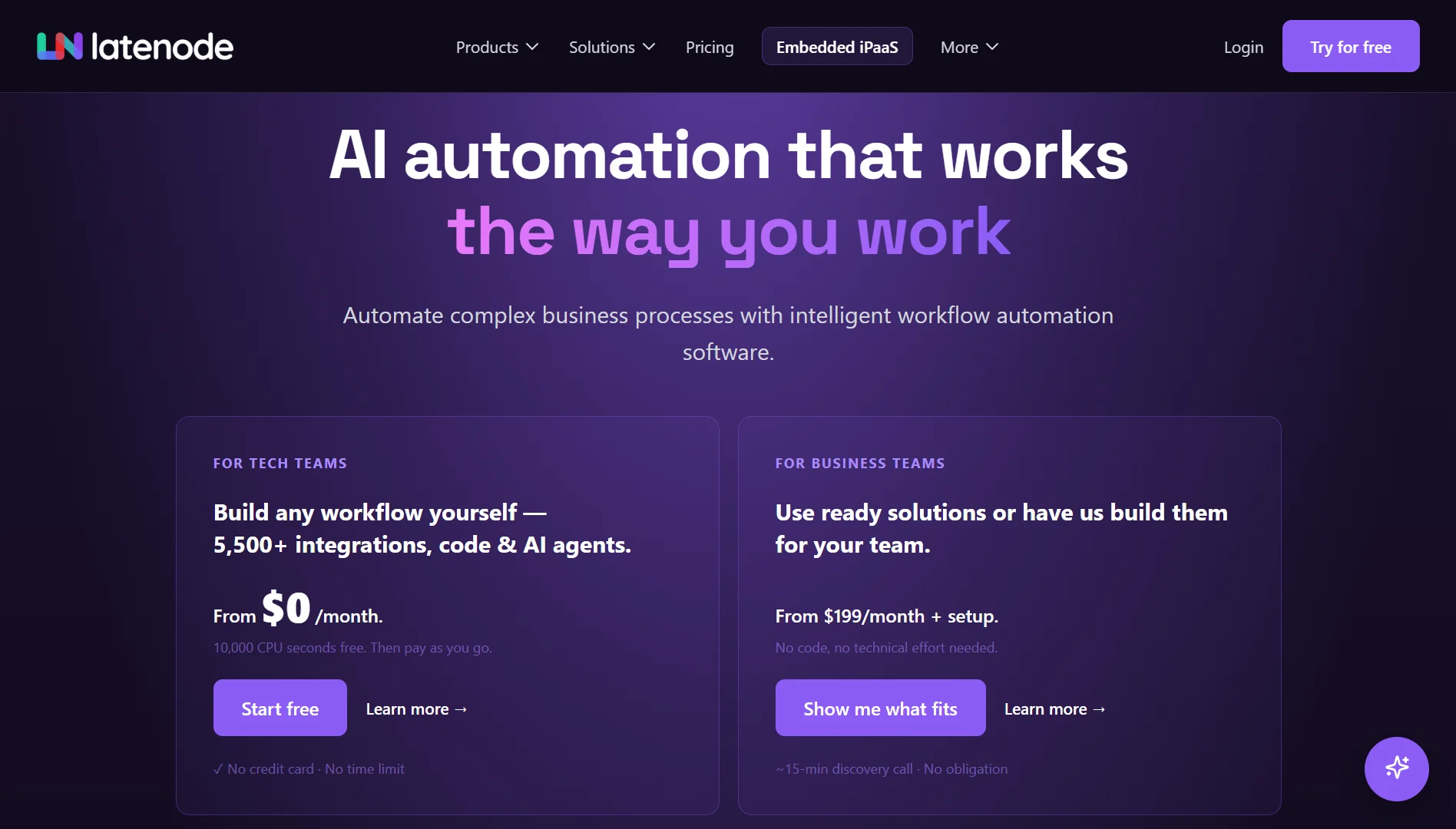
Latenode is a managed automation platform that eliminates the infrastructure headaches n8n users often face.
If you’ve spent time debugging server issues, managing API credentials, or handling security updates, Latenode’s approach will look appealing.
It bills by CPU seconds rather than per operation, which can significantly reduce costs for complex workflows.
So, instead of paying for every step in a multi-step workflow, you pay for runtime. This is a major difference from Zapier and Make’s pricing models.
Latenode includes a full-code JavaScript node that lets you write custom logic directly in your workflows, something n8n also offers but that requires technical expertise to use effectively.
The AI Agent Builder supports 1,200+ AI models with a single subscription, eliminating the need for separate API key management.
For teams that don’t want to build automation themselves, Latenode offers managed services where experts build workflows for you.
Implementation typically takes under 20 hours, versus 60+ hours for self-hosted solutions.
Latenode features simplified implementation, lower total cost of ownership, managed infrastructure, and no per-operation fees.
4) Make
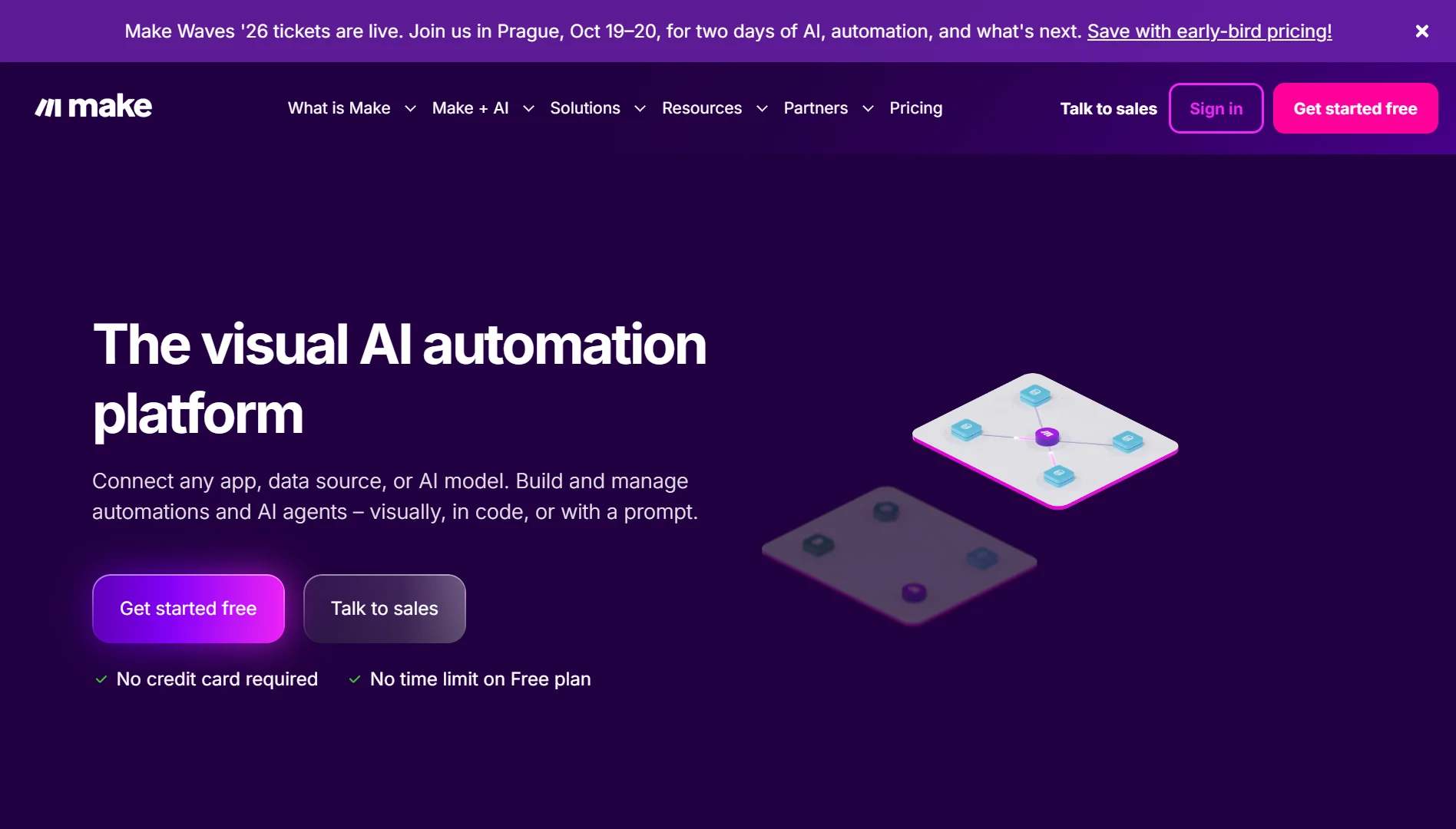
Make is the middle ground between n8n’s complexity and Zapier’s simplicity.
Its visual workflow builder shows all steps and connections in detail, making it easier to understand complex automation logic compared to Zapier’s more linear approach.
Make supports advanced automation scenarios, including branching, loops, parallel execution, and data transformation.
For users who find n8n too technical but Zapier too limiting, Make hits a sweet spot.
It integrates with around 1,000 native apps and supports custom API calls for services outside its library. Pricing starts at $9/month, making it more affordable than Zapier for many use cases.
It is a great n8n alternative if you want a lower learning curve for non-developers, affordable pricing, and strong visual workflow design.
5) Lindy
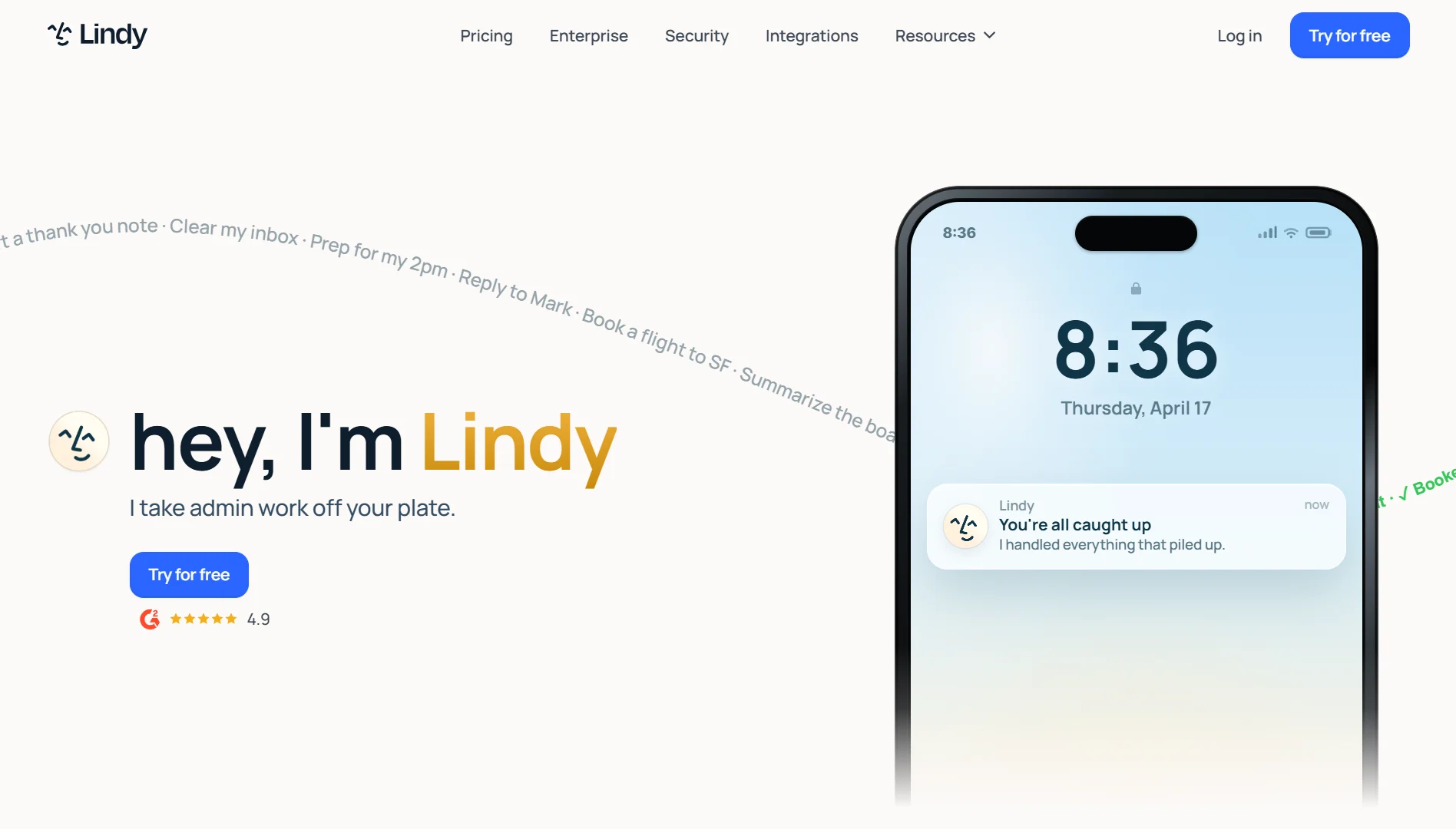
Lindy is an AI executive assistant rather than a workflow builder. You interact with Lindy through chat (including iMessage), giving it natural-language instructions to handle administrative work.
It connects to your email, calendar, Slack, and hundreds of other apps through Pipedream integrations.
Lindy can draft email replies in your voice, schedule meetings, take notes during calls, send follow-ups, and track to-dos. Users report getting 2 hours back per day from the automation.
What’s particularly interesting about Lindy is how it demonstrates the shift from workflow automation to agentic automation.
Instead of building visual pipelines, you simply tell Lindy what you want done, and the agent figures out the steps.
Its recent 3.0 release introduced Autopilot, which gives each agent its own cloud computer to navigate internal tools and legacy systems that lack APIs.
Lindy is HIPAA-compliant and offers enterprise SSO and audit logs.
It’s perfect if you are looking for zero setup for end users, natural language interaction, and personal assistant capabilities that n8n simply doesn’t offer.
6) Pipedream
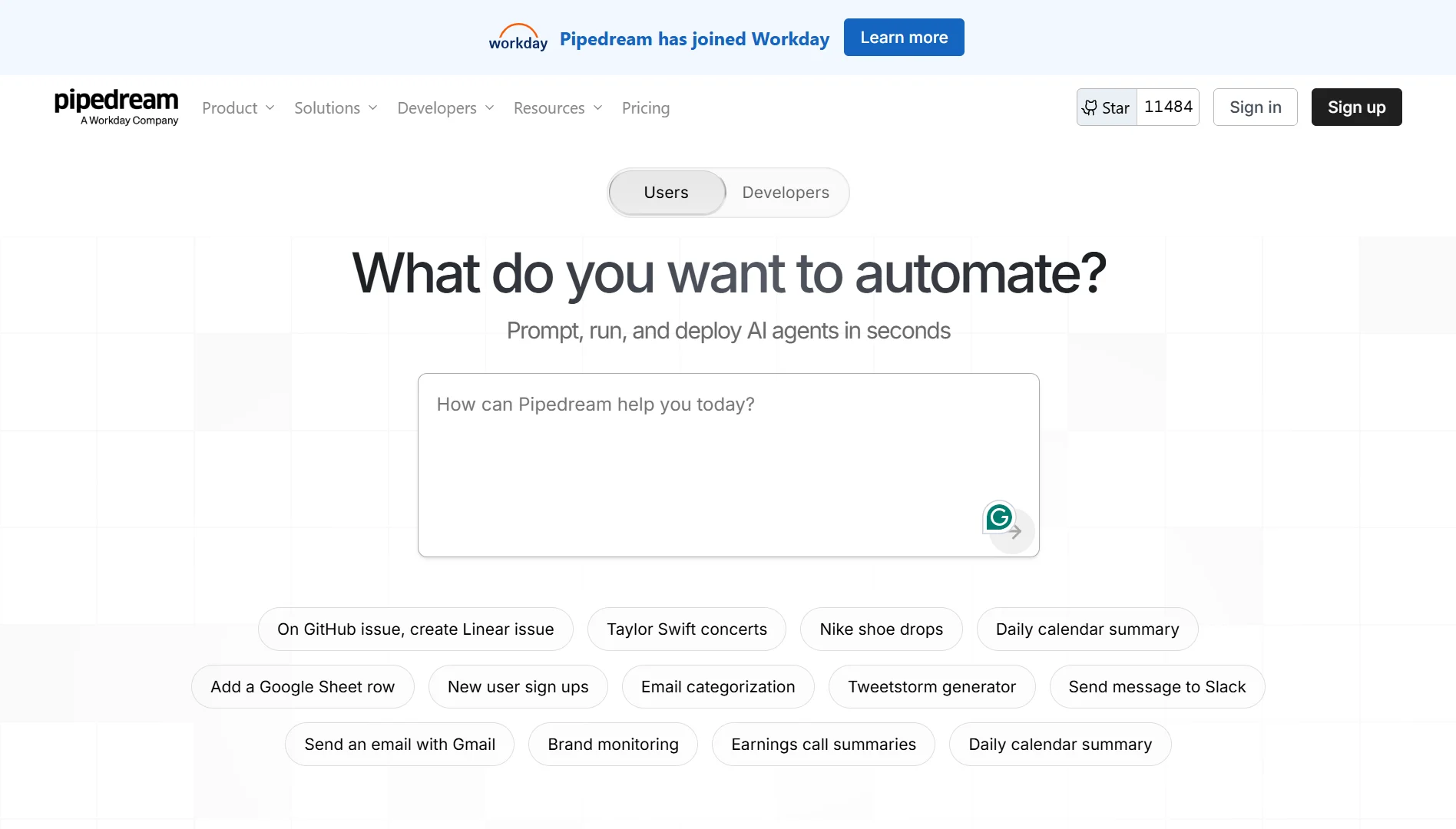
Pipedream is an integration platform built for developers, similar to n8n in its technical orientation but with important differences.
It’s a free, hosted platform for connecting apps and developing event-driven automations, supporting Node.js, Python, Golang, and Bash code.
What makes Pipedream unique is its GitHub component registry, which contains the code for all pre-built integrations.
This source-available model lets you avoid boilerplate code for common API integrations while still customizing everything.
Pipedream processes billions of events and is built for scale, with infrastructure that has handled over 10 million events per second.
It offers built-in services such as queues, data stores, and one-click private networks for quickly creating agents. It has demonstrated SOC 2 compliance and can provide SOC 2 Type 2 reports upon request.
Lindy actually uses Pipedream’s infrastructure for many of its app integrations.
It features a hosted platform (no self-hosting burden), managed authentication across 3,000+ apps, built-in services, and scalability, making it a good n8n alternative.
7) Relevance AI
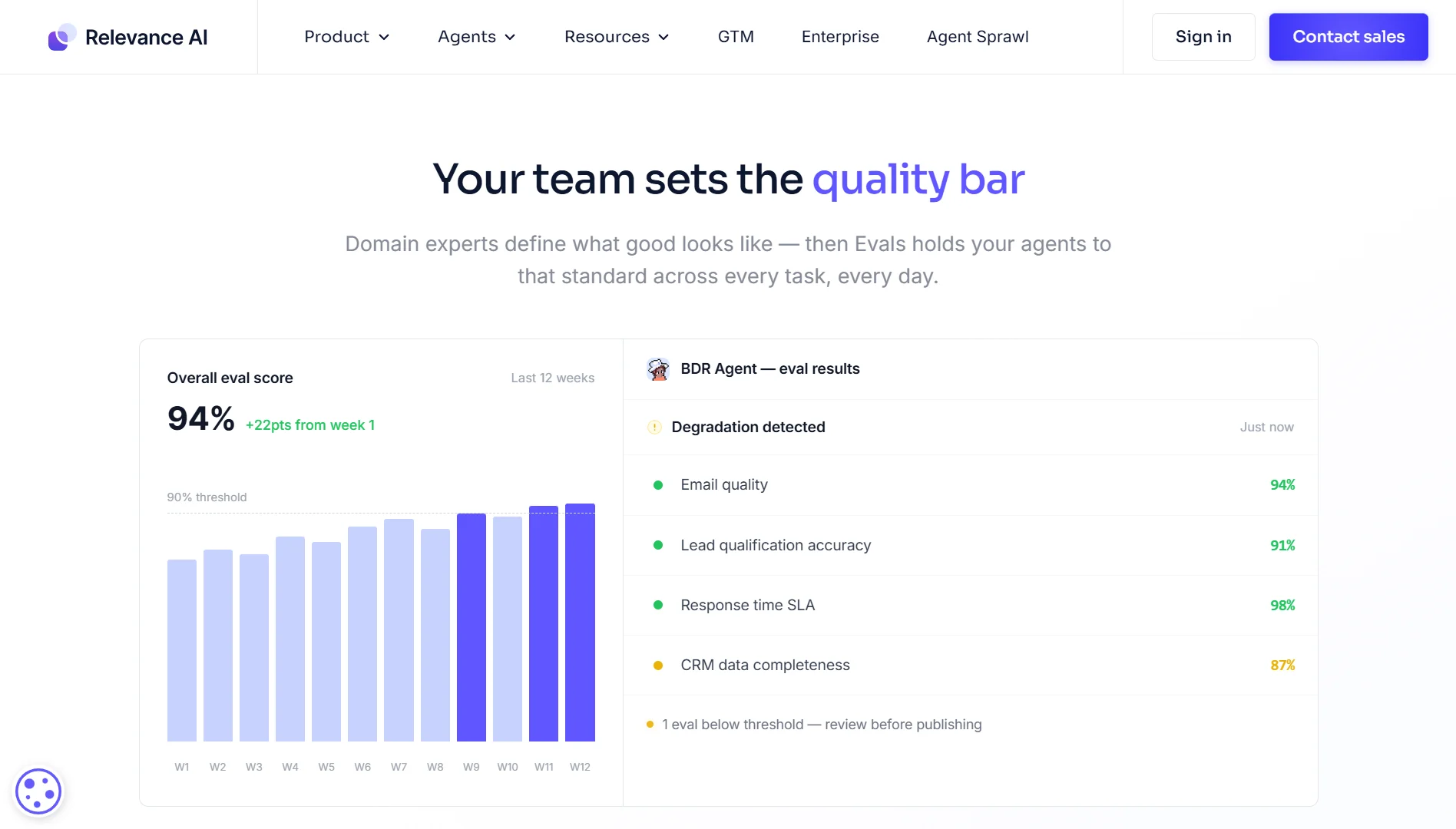
Relevance AI is designed for GTM and high-growth teams that need AI agents to drive business impact.
Unlike n8n’s workflow automation focus, Relevance is built around autonomous AI agents that can work alongside domain experts.
It maps a maturity model from L1 (assisted) to L4 (self-driving) AI agents, helping organizations progress toward full autonomy.
This is a different conceptual framework from n8n’s node-based workflow model.
Relevance includes 1,000+ native connectors, MCP support, and a built-in testing framework that lets teams evaluate agents.
Domain experts can define what good looks like, and the Relevance holds agents to that standard. Evals track performance, and the system can detect degradation before agents are published.
For enterprise teams, Relevance offers granular access controls, version history, audit logs, and human-in-the-loop approval gates.
It supports multi-region deployments to meet data residency requirements.
It is a perfect n8n alternative for genetic autonomy, evaluation framework, domain expert ownership, and GTM-specific capabilities.
8) StackAI
StackAI is an enterprise AI transformation platform trusted by organizations such as Mayo Clinic, MIT, and BAE Systems.
It’s designed for IT and enterprise architecture teams that need to bring AI agents into regulated environments.
The platform’s auto Agents feature lets teams describe what they want in natural language, and StackAI automatically generates a complete multi-step AI agent.
This is a stark contrast to n8n’s manual node configuration. The generated agent isn’t a black box; it can explain itself, walking users through each component of the workflow.
StackAI supports deployment anywhere: multi-tenant cloud, VPC, or on-premises.
It holds HIPAA, SOC 2 Type II, ISO 27001, and GDPR certifications, which are significant for organizations in healthcare, finance, and government.
Human-in-the-loop features let you integrate oversight at automated decision points.
It’s best for enterprise security certifications, natural-language agent generation, and compliance-ready infrastructure.
How to Make the Right Choice For Workflow Automation
Know your primary need: Zapier or Make for simple data transfers; Relevance, xpander, or StackAI for complex AI agents; n8n or Pipedream for developer automations.
Assess your team’s technical capability: Non-technical teams: Zapier, Make, Lindy, or Relevance. Developers: n8n offers more flexibility.
Evaluate deployment and security requirements: Self-hosted: n8n, xpander, StackAI. Managed: Zapier, Make, Latenode, Pipedream. Regulated industries: StackAI (HIPAA, SOC 2, ISO, GDPR), Zapier (SOC 2, GDPR), Lindy (HIPAA). n8n security depends on your implementation.
Your scaling trajectory: Zapier gets expensive at high volume. n8n scales with your servers but needs DevOps. Latenode’s CPU-second pricing doesn’t multiply costs with more steps.
Integration depth and breadth: Zapier: 6,000+ integrations. Make: ~1,000. n8n: 350+ native but allows custom connectors.
Learn the pricing model: Zapier charges per operation. Make uses similar but cheaper. n8n: free self-hosted or ~$20/month cloud. Latenode: CPU seconds. xpander: from $485/month cloud.
Match the tool to your specific use case: Simple transfers: Zapier. Complex visual: Make. Developer automations: n8n/Pipedream. AI agents: Relevance/xpander/StackAI. Personal assistance: Lindy. Managed infrastructure: Latenode. Enterprise governance: StackAI/xpander.
Final Take on n8n vs Alternatives
n8n offers developers deep customization and control, but its steep learning curve, self-hosting demands, and limited AI capabilities make it unsuitable for many teams.
If you lack DevOps resources or need autonomous agents, consider alternatives such as Zapier, Make, Latenode, or dedicated AI agent platforms.
If self-hosting n8n is your choice, you need reliable infrastructure. We provide managed hosting with one-click deployment and 24/7 support, plus VPS plans for OpenClaw.
The right choice depends on your team’s skills, security needs, and what you’re automating.