 Domain SearchInstantly check and register your preferred domain name
 Web Hosting
 cPanel HostingHosting powered by cPanel (Most user friendly)
 WordPress HostingHost your WordPress website with fast, secure, and affordable WordPress hosting in Kenya.
 KE Domains
 Reseller HostingStart your own hosting business without tech hustles
 Windows HostingOptimized for Windows-based applications and sites.
 Free Domain
 Affiliate ProgramEarn commissions by referring customers to our platforms
 Free HostingTest our SSD Hosting for free, for life (1GB storage)
 Domain TransferMove your domain to us with zero downtime and full control
 All DomainsBrowse and register domain extensions from around the world
 .Com Domain
 WhoisLook up domain ownership, expiry dates, and registrar information
 VPS Hosting
 Managed VPSNon techy? Opt for fully managed VPS server
 Dedicated ServersEnjoy unmatched power and control with your own physical server.
 Website Builder
 Online Store BuilderLaunch a professional e-commerce store without writing code.
 Web Design ServiceGet a custom-designed website tailored to your brand and goals. From just KES 15,600
 BlogRead our guides on web hosting, online business, digital marketing, and more
 SupportOur support guides cover everything you need to know about our services
 ContactContact us via chat or email
If you have been shopping around for hosting in Kenya, chances are these two names keep popping up.
Truehost has built its whole identity around web hosting, while Safaricom is the telecom giant that added hosting as one more service inside its massive ecosystem.
Both are proudly Kenyan, both accept M-Pesa, and both will get a small business online without much fuss. But that is really where the similarities end.
The Truehost vs Safaricom hosting question comes down to what you actually need from a host.
Are you after the cheapest possible entry point with room to grow?
Or do you just want a simple website tied to a brand you already trust for airtime and data?
In this article, we will walk through pricing, performance, support, security, and long term value so you can make the call with real numbers in front of you, not guesswork.
Truehost vs Safaricom Hosting Quick Comparison

Before we get into the details, here is a side by side snapshot of how the two stack up on the things that are most important.
| Feature | Truehost | Safaricom Hosting |
|---|---|---|
| Starting price | From around KSh 188/month (billed annually/triennially) | KSh 1,500/year (Bronze) |
| Shared hosting storage (entry tier) | Up to 30GB SSD on starter plans | 500MB (Bronze), 2GB (Silver) |
| Domain registration | Yes, including .co.ke and .com | Yes, mainly .co.ke and .com |
| Free domain availability | Yes, on select annual plans | Not typically included |
| SSL certificate | Free, automated (Let’s Encrypt) on all plans | Paid, though a 30-day free trial exists |
| Bandwidth | Unlimited on most plans | Unlimited on all tiers |
| Email accounts | Unlimited on higher tiers | 10 to 200 depending on tier |
| Data center/server location | Nairobi based, plus international options | Nairobi based |
| Customer support | 24/7 live chat, local support | Business hours support, routed through general Safaricom care |
| Payment options | M-Pesa, card, PayPal | M-Pesa, card |
| Website migration | Free migration assistance | Not clearly advertised |
| Best suited for | Bloggers, small businesses, developers, agencies | Micro businesses already using Safaricom services |
Now let’s unpack what is actually behind these numbers.
1) Pricing & Package Value
This is where the gap becomes obvious pretty quickly.
Truehost’s entry level shared hosting starts as low as KSh 188 a month when you commit to longer billing cycles, and that plan already comes bundled with SSD storage, free SSL, and daily backups.
Even their mid tier Business plan, which sits around KSh 299 a month, gives you unlimited email accounts and roughly 5GB of storage, which is already more room than most Safaricom tiers below Gold.
Safaricom’s Bronze plan costs KSh 1,500 a year, which sounds cheap until you look at what you get for it: just 500MB of storage and 10 email accounts.
Move up to Silver at KSh 2,500 to KSh 3,800 a year (depending on whether you pick a .co.ke or .com domain) and you get 2GB of space.
Compare that to Truehost’s starter plans offering up to 30GB SSD storage at a similar or lower price point, and the per shilling value tilts heavily toward Truehost.
Where things even out slightly is at the top end.
Safaricom’s Enterprise and Enterprise Plus plans (KSh 7,100 to KSh 9,000 a year) start to look more like real business hosting, and if you are already paying for Safaricom Business internet or SIM cards, bundling everything under one biller might feel convenient.
Still, even at these higher tiers, storage limits remain modest compared to what Truehost throws in even at its lower price brackets.
One more thing worth flagging: domain renewal fees.
Truehost tends to keep renewal pricing closer to the first-year price, while some Kenyan hosts (Safaricom included) can bump up .co.ke renewal costs noticeably in year two.
Always check the renewal price before you commit, not just the flashy first-year figure.
2) Performance, Uptime, and Local Server Infrastructure
Both providers host on Kenyan servers, which is very critical if most of your visitors are local.
Lower latency means faster load times for anyone browsing from Nairobi, Mombasa, or anywhere else in the country, and that is a real advantage over hosts based abroad.
Truehost runs on SSD storage paired with LiteSpeed servers on its newer infrastructure, which generally translates to snappier page loads and better handling of traffic spikes, especially for WordPress sites.
They also offer server locations beyond Kenya, including Europe and other regions, so businesses targeting an international audience are not locked into one geography.
Safaricom’s reported uptime has actually been solid, with independent monitoring showing around 99.97 to 99.99 percent uptime over extended periods, and they do publish a 99.95 percent uptime SLA.
That said, there is no clear compensation policy if uptime dips below that promise, which is worth keeping in mind.
On the CDN front, neither provider bundles a free global CDN on entry level shared plans, so if speed for an international audience is crucial to you, you would likely need to layer on a service like Cloudflare regardless of which host you pick.
For a purely Kenya-facing site, both should feel reasonably fast day to day.
But if you expect meaningful traffic growth, Truehost’s infrastructure and higher resource ceilings give it more headroom before you start feeling the pinch.
3) Payment Options & Local Support Capabilities
M-Pesa is a given with both providers, which makes sense in this market.
Truehost also accepts card payments and PayPal, giving a bit more flexibility for anyone paying from outside Kenya or preferring not to use mobile money.
Support is where the difference becomes more noticeable.
Truehost runs 24/7 live chat support that is dedicated to hosting issues specifically, which matters a lot when your site goes down at an inconvenient hour.
Safaricom, on the other hand, is a telecom company first, and hosting support tends to get folded into their broader customer care system.
Several reviewers have noted that getting someone who actually understands hosting-specific problems can take longer than you would like, simply because your query is competing with SIM card and data bundle issues in the same support queue.
If your priority is a fast resolution when something breaks, that distinction carries real weight.
A five minute outage during a sales promotion can cost more than a year of hosting fees, so responsive, specialized support is not a minor detail.
4) Ease of Use, Control Panels, and Developer Features
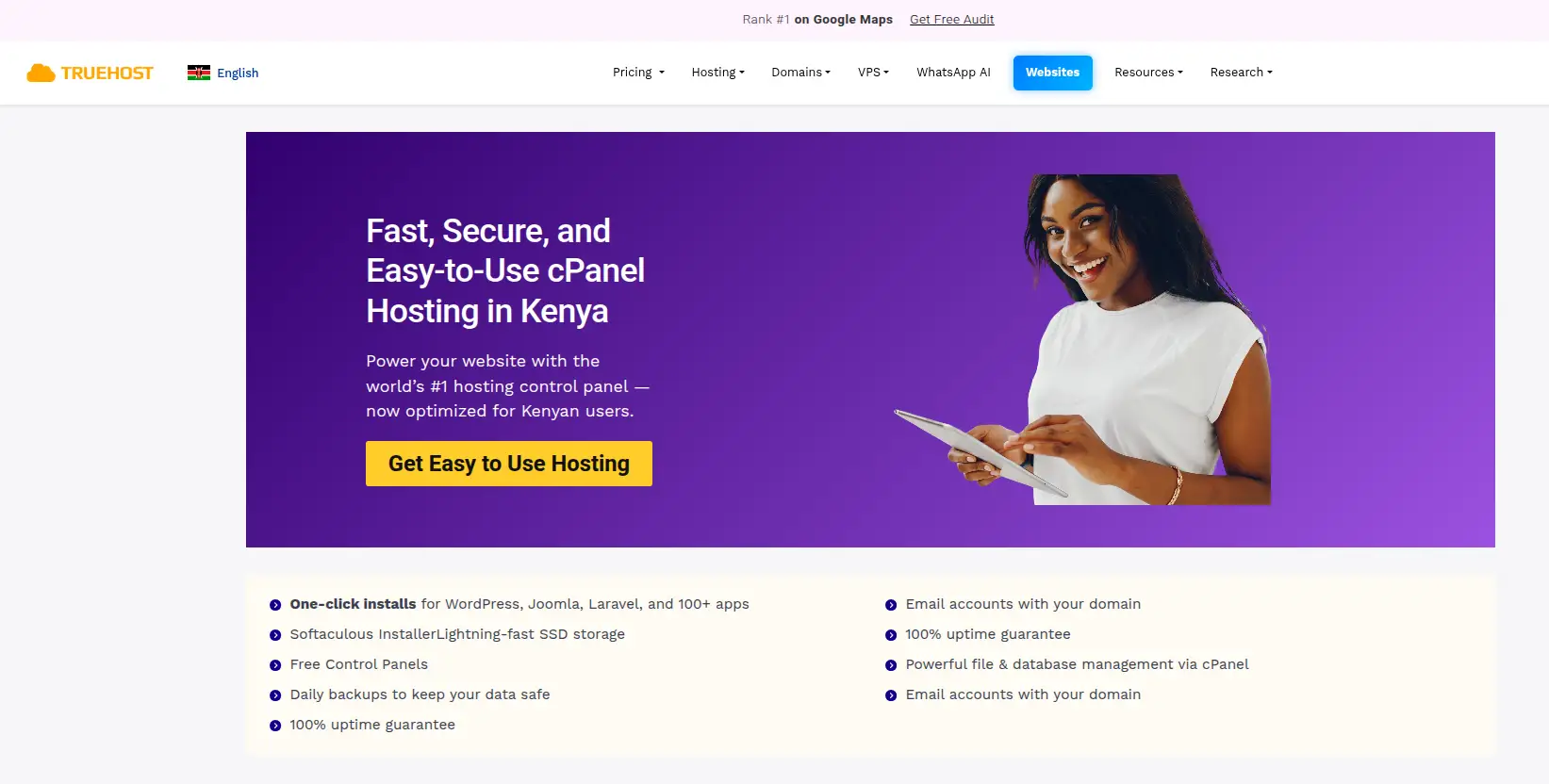
Truehost gives you full cPanel access across its shared hosting plans, along with one-click WordPress installers, which makes life easy whether you are a total beginner or a developer who just wants to move fast.
They have also expanded into supporting Node.js and Python on their hosting infrastructure, plus tools like self-hosted automation platforms for more advanced users.
That is a meaningful edge if you plan to build anything beyond a basic brochure website.
Safaricom’s control panel is functional but more basic, built around simplicity for small business owners rather than flexibility for developers.
There is no dedicated WordPress optimization layer, and if you want your site tuned specifically for WordPress performance, you are largely on your own.
For someone who just wants to upload a simple site and manage email, that simplicity might actually be a plus.
But for anyone planning to scale, add plugins, or eventually bring in a developer, Truehost’s toolset gives you a lot more to work with.
5) Security & Backups
This section deserves your full attention, because it is where the two providers genuinely diverge in a way that could cost you real data.
With Truehost, every plan includes free daily backups as standard, which means if something goes wrong, whether it is a bad plugin update or a hacking attempt, you have a recent copy to roll back to without paying extra.
On top of that, Truehost bundles free automated SSL through Let’s Encrypt on all its hosting plans, and layers on Imunify360 for malware scanning and protection.
For anyone running an online store or a site that handles customer information, this combination of daily backups and built-in malware protection is not a nice-to-have. It is close to essential.
Here is the part that catches a lot of people off guard.
Safaricom does run infrastructure-level backups, but your actual website content and email are not included in that backup.
In plain terms, if your site data gets corrupted or accidentally deleted, restoring it is on you, not Safaricom.
Backup assistance is available, but usually at an extra cost. On the security side, SSL certificates are not free by default.
There is a 30-day free trial, but after that you are paying for a certificate that many other hosts, Truehost included, give away for free indefinitely.
If data loss keeps you up at night, or if you simply do not want to think about manual backups every week, this alone might settle the decision for you.
Which Hosting Is Best for You?
After going through pricing, performance, support, and security side by side, Truehost comes out ahead for most Kenyan website owners.
It is the better choice for users who want a broader range of hosting options, easier scalability, and hosting products actually designed around websites and online businesses, rather than as an add-on to a telecom package.
Safaricom, on the other hand, may still appeal to customers who prefer keeping their digital services within the Safaricom ecosystem, especially for something small and low stakes like a basic informational site.
The reasoning here is not about picking a favorite brand. It comes down to what each company was built to do.
Truehost exists purely to host websites, so features like free daily backups, free SSL, malware protection, and 24/7 specialized support are baked into the core offering rather than treated as extras.
Safaricom’s hosting service, while genuinely useful for simple needs, was built as a side offering within a much bigger telecom business, and that shows in the gaps around backups, SSL costs, and support responsiveness.
If you are running a blog, an online store, or any business site that you expect to grow, Truehost gives you more room to expand without hitting a wall.
If all you need is a very basic, low traffic page and you already live inside the Safaricom ecosystem for everything else, their hosting will technically get the job done.
Either way, now you have the real numbers to decide for yourself.
Frequently Asked Questions
Is Truehost better than Safaricom hosting?
For most website owners, yes, mainly because of storage value, free SSL, included backups, and more dedicated hosting support. Safaricom can still work well for very basic sites tied closely to the Safaricom ecosystem.
Is Safaricom hosting good for WordPress?
It can run WordPress, but there is no managed WordPress optimization, so performance and security tuning is left to you. Truehost offers one-click WordPress installs with better underlying infrastructure for it.
How much does hosting cost in Kenya?
Shared hosting in Kenya generally ranges from about KSh 950 to KSh 19,000 a year depending on storage, features, and the provider you choose. Truehost sits near the lower end while offering more storage per shilling.
Does Truehost offer hosting in Kenya?
Yes, Truehost has Nairobi based servers along with international server options, and has been operating in the Kenyan market for over a decade.
Does Safaricom offer website hosting?
Yes, Safaricom runs a shared hosting service through its Cloud Services platform, tiered into Lite, Bronze, Silver, Gold, Premium, Enterprise, and Enterprise Plus packages.
Which is cheaper, Truehost or Safaricom?
Truehost is generally cheaper on a per-gigabyte basis, since its entry plans include significantly more storage and free extras like SSL and backups at a comparable or lower price.
Which is better for a small business in Kenya?
Truehost tends to suit growing small businesses better because of its scalability, better support, and included security features. Safaricom can suit a very small, simple business site, especially one already deep in the Safaricom ecosystem.
Can I transfer my website from Safaricom to Truehost?
Yes, and Truehost typically offers free migration assistance, which takes the technical hassle off your plate.
Can I register a .co.ke domain with Truehost?
Yes, Truehost supports .co.ke domain registration alongside .com and other extensions.
Which hosting is better for an ecommerce website in Kenya?
Truehost is the stronger option here, mainly because of its higher storage ceilings, free SSL for secure checkouts, daily backups, and malware protection, all of which matter more once real money is moving through your site.