 Domain SearchInstantly check and register your preferred domain name
 Web Hosting
 cPanel HostingHosting powered by cPanel (Most user friendly)
 WordPress HostingHost your WordPress website with fast, secure, and affordable WordPress hosting in Kenya.
 KE Domains
 Reseller HostingStart your own hosting business without tech hustles
 Windows HostingOptimized for Windows-based applications and sites.
 Free Domain
 Affiliate ProgramEarn commissions by referring customers to our platforms
 Free HostingTest our SSD Hosting for free, for life (1GB storage)
 Domain TransferMove your domain to us with zero downtime and full control
 All DomainsBrowse and register domain extensions from around the world
 .Com Domain
 WhoisLook up domain ownership, expiry dates, and registrar information
 VPS Hosting
 Managed VPSNon techy? Opt for fully managed VPS server
 Dedicated ServersEnjoy unmatched power and control with your own physical server.
 Website Builder
 Online Store BuilderLaunch a professional e-commerce store without writing code.
 Web Design ServiceGet a custom-designed website tailored to your brand and goals. From just KES 15,600
 BlogRead our guides on web hosting, online business, digital marketing, and more
 SupportOur support guides cover everything you need to know about our services
 ContactContact us via chat or email
Scroll through almost any hosting provider’s pricing page and you will run into two words that sound similar but aren’t quite saying the same thing, unlimited bandwidth and unmetered bandwidth.
Both show up constantly in hosting marketing, and both are easy to misread as a promise of limitless everything.
They aren’t.
Unlimited and unmetered describe two different aspects of how a host handles your data transfer, but neither one means unlimited network speed, unlimited server capacity, unlimited CPU or RAM, or unlimited storage.
A plan can advertise unlimited bandwidth and still slow down under heavy traffic, or cap out on storage long before bandwidth becomes the issue.
Knowing the difference between unlimited vs unmetered bandwidth is genuinely useful when comparing hosting plans in Kenya, since the wording alone won’t tell you whether a plan can actually handle your website’s traffic.
This article walks through bandwidth quotas, connection capacity, traffic spikes, resource limits, fair-use policies, and what Kenyan website owners should actually be comparing instead of just the headline word on a pricing page.
Unlimited vs Unmetered Bandwidth Comparison
| Feature | Unlimited Bandwidth | Unmetered Bandwidth |
|---|---|---|
| Fixed monthly bandwidth quota | No stated quota | No metered quota |
| Bandwidth measured against allowance | Generally no | No |
| Physical network capacity | Finite | Finite |
| Connection speed | Plan-dependent | Plan-dependent |
| CPU limits | Still apply | Still apply |
| RAM limits | Still apply | Still apply |
| Storage limits | Still apply | Still apply |
| Fair-use policy | May apply | May apply |
| Overage charges | Usually not based on GB | Usually not based on GB |
| Traffic spikes | Generally accommodated within plan limits | Generally accommodated within connection capacity |
| High-volume traffic | Depends on overall resources | Depends on connection/resource capacity |
| Unlimited network speed | No | No |
| Unlimited server resources | No | No |
| Best interpretation | No stated transfer cap under normal use | No usage-based bandwidth quota |
On paper, the two look nearly identical, and in practice they often behave that way too.
The terminology becomes clearer once you look at what is actually happening behind the scenes, rather than just the label on the plan.
How Unlimited vs Unmetered Bandwidth Work
1) Bandwidth Measurement and Monthly Limits
Traditional hosting plans used to work off a fixed monthly transfer allowance, 100 GB, 500 GB, or whatever the plan specified.
Once you crossed that number, you either paid an overage fee or your site got throttled or suspended until the next billing cycle.
Unlimited and unmetered plans both move away from that model, but in slightly different ways.
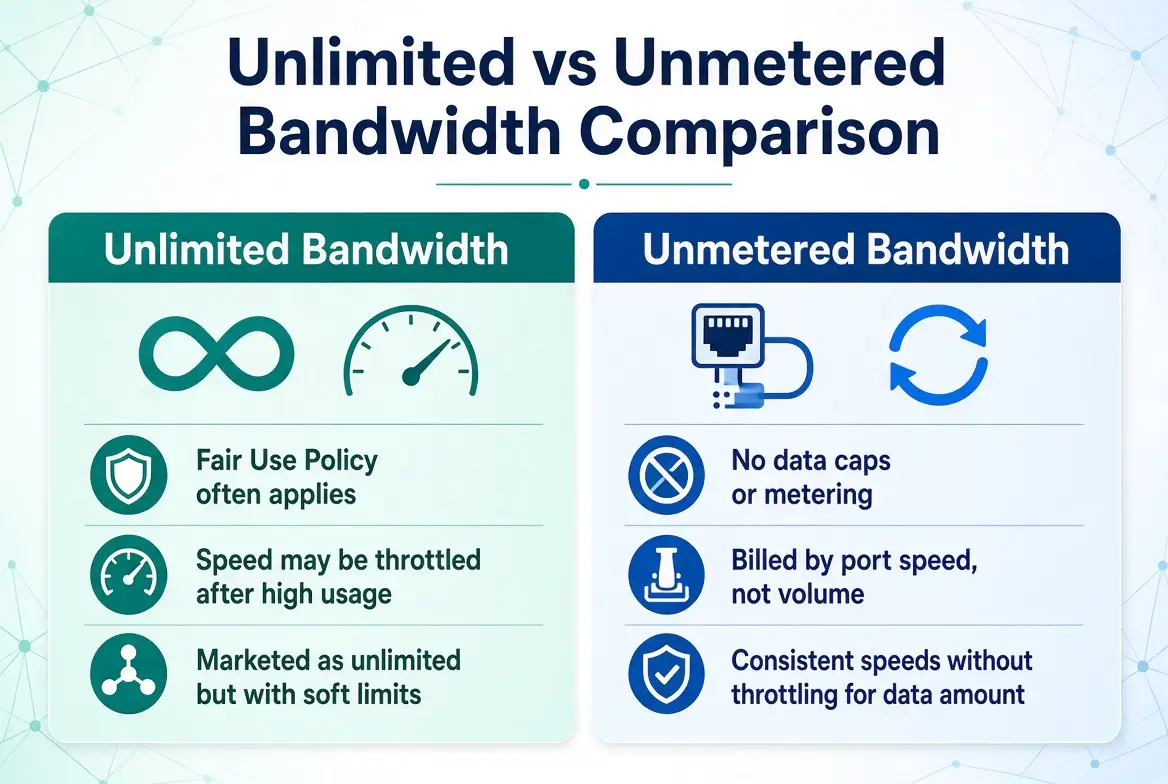
A provider offering unlimited bandwidth generally isn’t assigning any fixed monthly transfer quota at all.
A provider offering unmetered bandwidth isn’t measuring, or metering, your usage against an allowance in the first place.
In both cases, the practical result for most websites is the same, you aren’t watching a usage counter every month, but neither term means your website can transfer data at an unlimited rate.
There is still a ceiling somewhere, it’s just not expressed as a simple GB number.
2) Network Capacity and Connection Speed
How much data your site can transfer and how quickly it transfers are two different questions.
Unmetered does not mean unlimited speed, and unlimited bandwidth does not mean unlimited throughput.
Every hosting server, no matter what the plan is called, connects to a physical network with finite capacity.
That distinction becomes more relevant as traffic grows.
A handful of daily visitors will never notice a connection speed limit.
Thousands of simultaneous visitors might, especially if the hosting environment is shared with other accounts pulling on the same physical resources.
3) What Happens During Traffic Spikes?
Bandwidth labels are especially important in the moments a website suddenly gets busy.
A news article that takes off, an online shop running a major promotion, a Kenyan business launching a new product, a seasonal campaign, or a blog post shared widely on social media.
In these situations, the real bottleneck is often not bandwidth at all.
It’s more likely to be CPU, RAM, PHP workers, database activity, or the number of concurrent connections the server can handle at once.
A site can have technically unlimited bandwidth and still slow to a crawl during a spike because the server ran out of processing capacity long before it ran into any data transfer limit.
4) CPU, RAM and Other Hosting Resources

Bandwidth only describes how much data moves in and out of your site, not how much work the server can actually process.
The resources that determine that are separate:
- CPU
- RAM
- Processes
- PHP workers
- I/O
- Concurrent connections
This is why a shared hosting account can advertise unlimited or unmetered bandwidth while still having clear limits on computing resources.
A practical example is a WordPress site during a traffic surge, every visitor triggers database queries and PHP requests, and it’s usually CPU and RAM that hit their ceiling first, not bandwidth.
5) Storage, Inodes and File Limits
Bandwidth and storage are entirely separate resources, and it’s a mistake to assume unlimited or unmetered bandwidth also means unlimited storage.
Storage-related limits include:
- Disk space
- Inodes
- Number of files
- Database size
- Backup storage
- Large media files
This counts especially for websites with a lot of images, downloadable files, videos, or a large WordPress media library, since those can fill up allotted storage well before bandwidth ever becomes a concern.
6) Fair-Use and Acceptable-Use Policies
Somewhere between the marketing language on a pricing page and the provider’s actual hosting policies sits the fair-use policy.
This typically covers things like excessive resource consumption, server abuse, large-scale file distribution, and streaming.
It’s worth being clear that a fair-use policy isn’t some hidden catch designed to trip people up.
Unlimited normally refers to bandwidth usage within the provider’s intended hosting environment, a typical website’s normal traffic pattern, not unlimited consumption of every server resource at once.
A site running within normal usage patterns is unlikely to ever encounter a fair-use issue.
7) Large Files, Downloads and Streaming
Software downloads, large PDFs, video libraries, audio files, live streaming, and photography portfolios all put a different kind of pressure on hosting than a typical text-and-image website.
Even with bandwidth advertised as unlimited or unmetered, shared hosting may not be the right infrastructure for a site delivering large amounts of media regularly, since the underlying CPU, RAM, and storage limits still apply.
For media-heavy websites, a content delivery network (CDN) or dedicated media storage is often a better fit than trying to push everything through a standard shared hosting plan.
8) Website Performance and Loading Speed
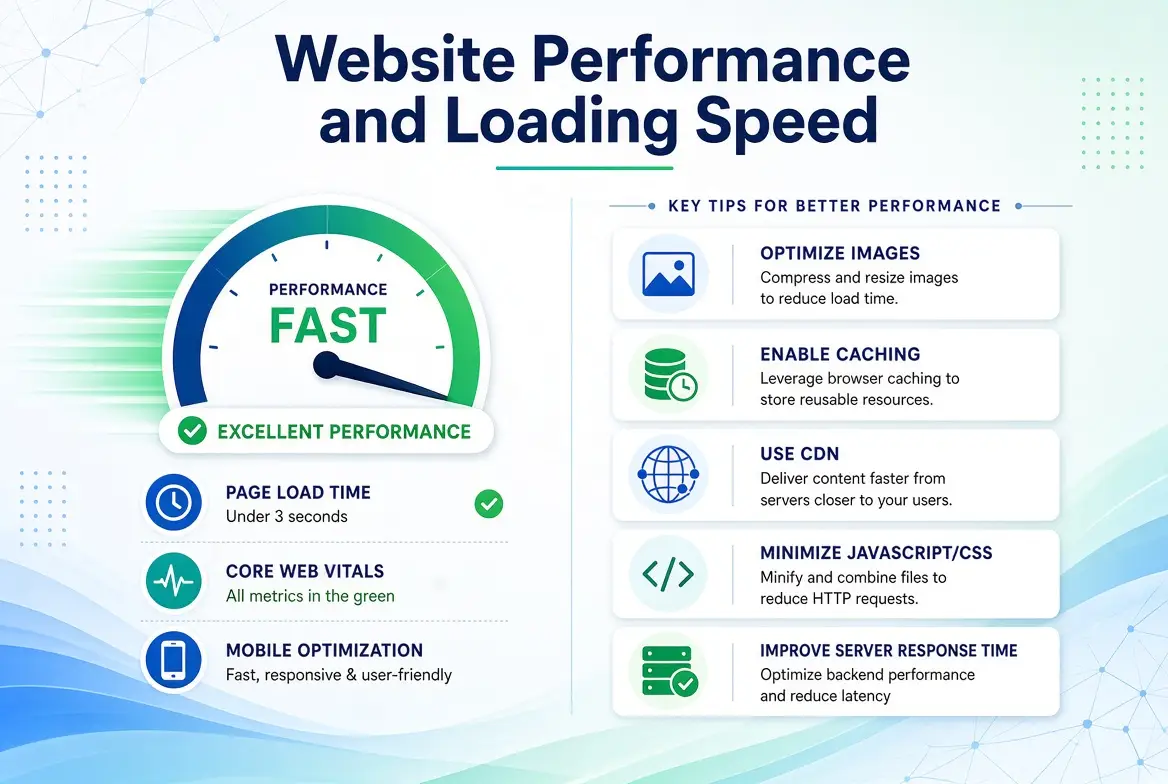
Bandwidth is only one factor in how fast a website loads. Performance also depends on:
- CPU
- RAM
- Network capacity
- Storage technology
- Database performance
- Caching
- CDN
- Server configuration
- Server location
A website hosted in or near its target market often benefits from lower latency and faster load times, which is why server location and appropriate infrastructure is critical just as much as the bandwidth label.
Neither unlimited nor unmetered bandwidth automatically makes a website faster.
9) Hosting Cost and Billing
Bandwidth terminology can affect how buyers interpret hosting prices, even when it shouldn’t.
It’s worth checking a few things before assuming a plan’s pricing is fully predictable:
- Fixed hosting prices
- Data-transfer overage charges
- Traffic-related billing
- Promotional prices
- Renewal prices
- Billing cycles
Both unlimited and unmetered plans can offer predictable hosting costs, but it’s worth checking the provider’s actual terms rather than assuming the word unlimited guarantees there can never be additional costs down the line, especially around renewal pricing after an introductory period.
10) Scalability When Your Website Outgrows Shared Hosting
Bandwidth isn’t the only reason a website eventually needs to move up. The typical progression looks like this:
- Shared hosting
- Higher-tier shared or business hosting
- VPS
- Cloud hosting
- Dedicated server
A website can have more than enough bandwidth and still hit limits on CPU, RAM, I/O, database performance, or concurrent processes.
In those situations, upgrading to a plan with more computing resources, rather than searching for a host promising even more bandwidth, is usually the change that actually solves the problem.
So, Should You Choose Unlimited or Unmetered Bandwidth?
Neither is automatically better.
Unlimited generally means there is no stated bandwidth quota under normal use, while unmetered means your data transfer isn’t counted against a fixed allowance, but in both cases, the connection still has finite capacity behind it.
For most website owners, the more useful question isn’t whether a plan says unlimited or unmetered.
It’s whether the hosting package provides enough of everything else a website actually needs to run well:
- CPU
- RAM
- Storage
- Network capacity
- Concurrent connections
- PHP workers
- Other resources
The right answer also depends on the type of website you’re running and the traffic you expect.
A small blog and a busy online store have very different resource needs, regardless of what either hosting plan calls its bandwidth.
If you’re comparing hosting plans in Kenya, Truehost’s plans are worth a look alongside whatever bandwidth label a provider is using, since the resources behind that label are what will actually determine how your site performs.
Frequently Asked Questions
Can I change from an unlimited bandwidth plan to an unmetered plan?
Switching depends on what plans your provider offers and their upgrade or migration process. In practice, changing the label alone may not produce any meaningful technical difference.
u003cstrongu003eCan I use unlimited bandwidth hosting for multiple websites?u003c/strongu003e
That depends on the plan’s website or domain limits, not the bandwidth label. Having unlimited bandwidth doesn’t automatically mean a plan supports unlimited websites.
u003cstrongu003eDoes unlimited bandwidth affect my website’s SEO?u003c/strongu003e
Not directly. The bandwidth label itself isn’t an SEO factor, but hosting performance and availability can indirectly affect user experience, which search engines do take into account.
u003cstrongu003eDoes bandwidth affect website hosting costs?u003c/strongu003e
It can, depending on whether a plan uses a fixed allowance, charges overage fees, or avoids GB-based billing entirely. Always check the provider’s specific pricing and usage terms.
u003cstrongu003eHow can I monitor my website’s bandwidth usage?u003c/strongu003e
Most hosting control panels include usage statistics, and some providers offer additional resource monitoring tools. Keep in mind that analytics traffic figures and actual hosting bandwidth consumption aren’t necessarily measuring the same thing.
u003cstrongu003eHow do I know how much bandwidth my website is using?u003c/strongu003e
Usage is driven by page size, visitor numbers, downloads, images, videos, and API requests. Your hosting provider’s own statistics will usually give a more accurate figure than estimating from analytics alone.
u003cstrongu003eCan a CDN reduce my website’s bandwidth usage?u003c/strongu003e
Yes. A CDN serves cached content from edge locations closer to the visitor, instead of the origin server handling every single request. This is a different benefit from simply having unlimited or unmetered bandwidth, and the two often work best together.
u003cstrongu003eCan I host videos on unlimited bandwidth hosting?u003c/strongu003e
Technically possible doesn’t always mean appropriate. Video hosting puts real pressure on storage, server resources, and streaming workload, and may run into a provider’s acceptable-use policy. Dedicated video or CDN infrastructure is often a better fit for heavy video delivery.
u003cstrongu003eWhat happens if my website suddenly goes viral?u003c/strongu003e
The outcome depends on available CPU, RAM, network capacity, caching, and the hosting provider’s resource policies, not the bandwidth label. A CDN and proper caching can help absorb a sudden spike in traffic.
u003cstrongu003eDoes bandwidth usage reset every month?u003c/strongu003e
That depends on the plan type. Metered plans with a monthly allowance typically reset each billing cycle, while plans without a fixed bandwidth quota don’t have anything to reset in the first place. Check your specific plan’s billing and usage terms to be sure.