 Domain SearchInstantly check and register your preferred domain name
 Web Hosting
 cPanel HostingHosting powered by cPanel (Most user friendly)
 WordPress HostingHost your WordPress website with fast, secure, and affordable WordPress hosting in Kenya.
 KE Domains
 Reseller HostingStart your own hosting business without tech hustles
 Windows HostingOptimized for Windows-based applications and sites.
 Free Domain
 Affiliate ProgramEarn commissions by referring customers to our platforms
 Free HostingTest our SSD Hosting for free, for life (1GB storage)
 Domain TransferMove your domain to us with zero downtime and full control
 All DomainsBrowse and register domain extensions from around the world
 .Com Domain
 WhoisLook up domain ownership, expiry dates, and registrar information
 VPS Hosting
 Managed VPSNon techy? Opt for fully managed VPS server
 Dedicated ServersEnjoy unmatched power and control with your own physical server.
 Website Builder
 Online Store BuilderLaunch a professional e-commerce store without writing code.
 Web Design ServiceGet a custom-designed website tailored to your brand and goals. From just KES 15,600
 BlogRead our guides on web hosting, online business, digital marketing, and more
 SupportOur support guides cover everything you need to know about our services
 ContactContact us via chat or email
Anyone who has a website knows how gut-wrenching it is to see traffic stagnate or decline despite using the best SEO tools.
You might think you need better content or more keywords. Those things help, but there is something else you might be overlooking.
Does hosting affect SEO?
Yes, it does. Your hosting controls how fast your site loads, how often it is available, and whether Google trusts it. If your hosting is bad, your SEO will struggle despite how good your content is.
Let us look at how hosting affects SEO and what you can do about it.
Does Hosting Affect SEO?
Let’s say you have a beautiful website for your business in Nairobi, your blog about life in Mombasa, or your online shop selling goods around the country.
You spent weeks on the design, wrote content you are proud of, and are ready for significant web traffic.
But then, days go by. Weeks. The visitors are not coming. You check your Google rankings, and your site is nowhere to be found. It is frustrating, right?
You might be thinking, “Maybe I need to write more blog posts.” Or, “Perhaps I didn’t use the right keywords.”
While those are critical, there is a foundational element most people overlook: your web hosting.
Web hosting affects SEO. In fact, your hosting choice is one of the most critical technical decisions you will make for your website’s success.

Your website is like a car, your content is the engine, and your keywords are the fuel. Your web hosting? That is the road.
You could have the fastest car in the world, but if the road is full of potholes, mud, and keeps collapsing, you are not going to win any races.
In 2026, Google’s algorithms look at your keywords and the experience you provide to your visitors. Your hosting provider is responsible for that experience.
How Does Hosting Affect SEO?
There are different ways your hosting directly impacts your search engine rankings.
1) The Need for Speed And How Your Server Controls It
We all hate a slow website. You click a link, and you just sit there staring at a blank white screen.
In Kenya, where we are used to mobile data and sometimes unpredictable connections, speed is everything.
Google knows this. They use Core Web Vitals to measure your site’s speed and responsiveness.
A key part of this is LCP (Largest Contentful Paint). That is a fancy way of saying, “How long does it take for the main part of your page to show up on the screen?”
If your server is slow, your LCP will fail.
Why? Before your images and text can load, the server must wake up, process the request, and begin sending data. This initial delay is called TTFB (Time to First Byte).
Cheap hosting companies pack thousands of websites onto a single, underpowered server. Your site has to compete for resources.
When someone visits, the server is slow to respond because it is busy handling other sites. Google targets a TTFB under 500 milliseconds, but an overloaded server pushes it higher.
Google tracks this, and a slow server hurts your ranking.
Good hosting places your site on better servers with enough power and memory. The server responds immediately, keeping TTFB low and your site fast.
You can optimize your images and clean up your code, but if the server is slow, it is invain. You cannot fix a slow server by changing your website. You have to change your hosting.
2) Uptime

Have you ever tried to visit a website and got an error message saying the site is unavailable? That is downtime.
It happens to everyone occasionally, but if it happens a lot, you have a serious problem.
Google sends out little robots called crawlers to visit your site and see what is new. They do this to add your pages to their search results.
If your site is offline when these crawlers come, they cannot do their job. If this continues, Google will begin to lose trust in you.
They might view your site as unreliable and visit less often. Your new content won’t be indexed, and your rankings will suffer.
Apart from crawlers, what about your customers? If a potential customer in Kisumu clicks your link from a Google search at 9 PM and finds your site is down, they will not return.
This increases your bounce rate, which is another sign to Google that your site is not good.
When users immediately abandon your broken link to click on a competitor instead, search engines notice that negative signal. This double blow of failed crawls and lost traffic quickly destroys your hard-earned visibility, pushing your business further down the results page.
At Truehost, we guarantee 99.9% uptime. This means they promise your site will be available almost always.
3) Security
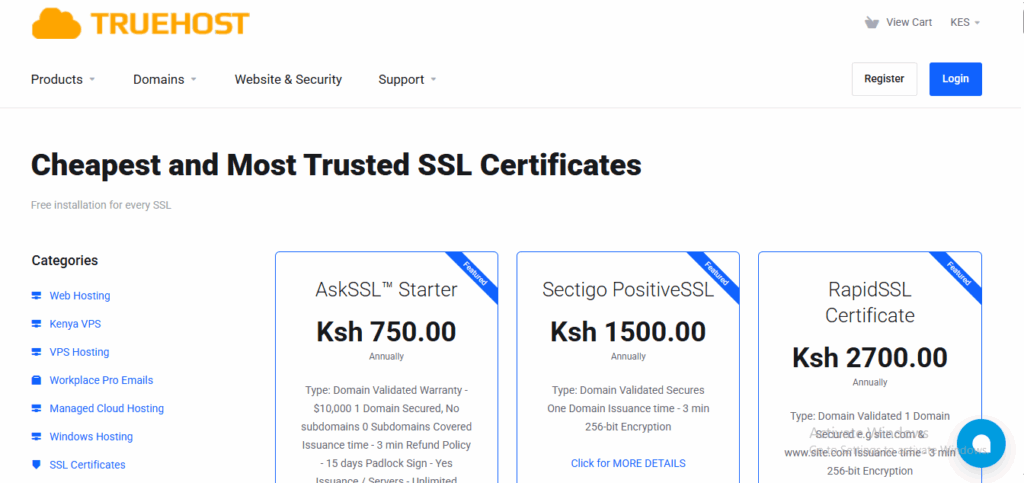
Nobody wants Google to send users to a website that could infect their computer with a virus or steal their credit card information. Google is very strict about this.
One of the most basic security features is an SSL certificate. You have seen this as the little padlock icon next to a website’s address. It means the connection between the user and the server is encrypted and secure.
Without SSL (HTTPS), Google warns users that your site is Not Secure. This scares people away. It is also a direct ranking factor, meaning sites with SSL (HTTPS) receive a small ranking boost.
Good hosting also protects you from hackers, malware, and DDoS attacks, where attackers flood your site with fake traffic to take it down.
4) The Bad Neighbour Effect on Shared Serviors
When you start out, you will likely use shared hosting. This means your website is stored on a server with many others. It is affordable, but there is a risk.
If another website on your server gets hacked, experiences a huge traffic spike, or starts sending spam, it can drain the server’s resources.
When this happens, your website will slow down or become unavailable.
Also, every server has an IP address. If a website on that server engages in spam or other harmful activity, the entire IP address can be blacklisted.
Because you share that IP, your innocent website can also be flagged, making it harder to rank.
A good hosting company like Truehost actively monitors its servers and removes these problematic websites to keep your site safe and fast.
5) Where Is Your Server?
This is especially important for us in Kenya. The physical location of your server is crucial.
Data travels at the speed of light, which sounds instantaneous, but it must travel long distances over wires and cables under the ocean.
If your target audience is in Kenya but your server is in the United States or Europe, every data request must make a round-trip. This adds latency.
A server in the US for a Kenyan user: Data must travel from Nairobi via undersea cables to the US and back. This takes time.
A server in Kenya or a nearby location for a Kenyan user: The shorter distance means data arrives faster.
This lightning-fast local response time keeps your visitors happy and engaged. It lowers your bounce rates significantly while ensuring search engine crawlers can index your pages without any friction or delay.
For a global audience, a CDN (Content Delivery Network) solves this by storing copies of your site on servers worldwide.
But for a business primarily serving Kenyans, having your website hosted on a server in Kenya, or at least in Europe, makes a huge difference in speed.
How to Prevent SEO Issues From Hosting

To ensure your hosting supports your SEO, you need a provider that handles the technical side. Truehoost offers you:
- Speed. We use NVMe SSD storage, the fastest drives available. Your site loads instantly. Google and your visitors are happy.
- Reliability. We guarantee 99.97% uptime. Your site is always open. Google can crawl it at any time, and customers can visit at any hour.
- Security. Every plan includes a free SSL certificate and free daily backups. We also monitor for hackers. You do not have to worry about safety.
- Local servers. Our servers are in Kenya. Your site loads faster for local customers, which Google notices and rewards.
- Room to grow. You can upgrade to a larger plan at any time without downtime. Your site stays fast even as your traffic grows.
- 24/7 support. Our team is always available to help.
Final Wrap
So, does hosting affect SEO? Yes. Your speed, uptime, security, and Google rankings all depend on it.
You can have great content, but if your hosting is slow or unreliable, none of it will work. Visitors will leave, and Google will stop sending people your way.
However, you can fix this today. Search engines reward websites that load instantly and stay online consistently.
When your infrastructure is rock-solid, search bots can crawl your pages efficiently, protecting your hard-earned visibility.
Choosing a optimized platform ensures your technical foundation actively boosts your search performance instead of dragging it down.
At Truehost, we offer you: Fast servers, 99.97% uptime, free SSL, free backups, and local servers in Kenya.
Do not let bad hosting hold you back.