 Domain SearchInstantly check and register your preferred domain name
 Web Hosting
 cPanel HostingHosting powered by cPanel (Most user friendly)
 WordPress HostingHost your WordPress website with fast, secure, and affordable WordPress hosting in Kenya.
 KE Domains
 Reseller HostingStart your own hosting business without tech hustles
 Windows HostingOptimized for Windows-based applications and sites.
 Free Domain
 Affiliate ProgramEarn commissions by referring customers to our platforms
 Free HostingTest our SSD Hosting for free, for life (1GB storage)
 Domain TransferMove your domain to us with zero downtime and full control
 All DomainsBrowse and register domain extensions from around the world
 .Com Domain
 WhoisLook up domain ownership, expiry dates, and registrar information
 VPS Hosting
 Managed VPSNon techy? Opt for fully managed VPS server
 Dedicated ServersEnjoy unmatched power and control with your own physical server.
 Website Builder
 Online Store BuilderLaunch a professional e-commerce store without writing code.
 Web Design ServiceGet a custom-designed website tailored to your brand and goals. From just KES 15,600
 BlogRead our guides on web hosting, online business, digital marketing, and more
 SupportOur support guides cover everything you need to know about our services
 ContactContact us via chat or email
Freelancing has transformed how people work and how websites, applications, and client projects are hosted. As workloads grow, shared hosting often starts showing its limitations through slower performance, restricted resources, and less control over the hosting environment.
For freelancers managing client websites, online portfolios, e-commerce stores, or business applications, these limitations can eventually affect productivity and user experience.
That is why many freelancers eventually move to VPS hosting. A Virtual Private Server (VPS) provides dedicated resources, including guaranteed RAM, CPU power, and storage, without the cost of a dedicated server. Unlike shared hosting, where multiple users compete for the same resources, a VPS gives you greater stability, improved performance, and more control over your hosting environment.
The benefits go beyond speed. VPS hosting allows freelancers to install custom software, configure servers to suit specific projects, and scale resources as their business grows.
It also makes it easier to manage multiple client websites from a single environment, often at a lower cost than maintaining several separate hosting accounts. For freelancers handling client work, a VPS can provide the professionalism, flexibility, and reliability needed to support growing workloads.
The challenge is choosing the right provider. Some VPS hosts focus on affordability, while others prioritize global infrastructure, managed services, or developer-friendly tools. The best choice depends on your budget, technical skills, client locations, and future growth plans.
To help narrow down the options, we’ve reviewed six VPS hosting providers that stand out for freelancers, offering everything from budget-friendly hosting and hands-off management to the performance needed to support clients worldwide.
1) TrueHost VPS

For freelancers serving clients across Africa, TrueHost offers a strong mix of affordability, local support, and regional performance that many international providers struggle to match.
Why It Fits Freelancers
TrueHost is built with African businesses and freelancers in mind. Its regional infrastructure helps deliver faster loading speeds for visitors in countries like Kenya, Nigeria, Ghana, and South Africa. It also supports local payment methods such as M-Pesa, making billing much more convenient.
Pricing
TrueHost’s Kenya VPS plans start at KSh 1,400/month and scale to KSh 5,600/month, making them an affordable option for freelancers and small agencies that need dedicated resources without a large upfront investment
Key Features
- cPanel/WHM access for familiar server management
- SSD storage for fast read/write performance
- Scalable RAM and CPU as your workload grows
- Local billing support, including M-Pesa payments
- 24/7 customer support with regionally knowledgeable staff
Performance Edge
Its biggest advantage is local infrastructure. Hosting closer to African audiences can improve page load times, user experience, and overall website performance.
Ideal For
Freelancers and small agencies serving African clients who want reliable VPS hosting with local support and affordable pricing.
2) Hostinger VPS
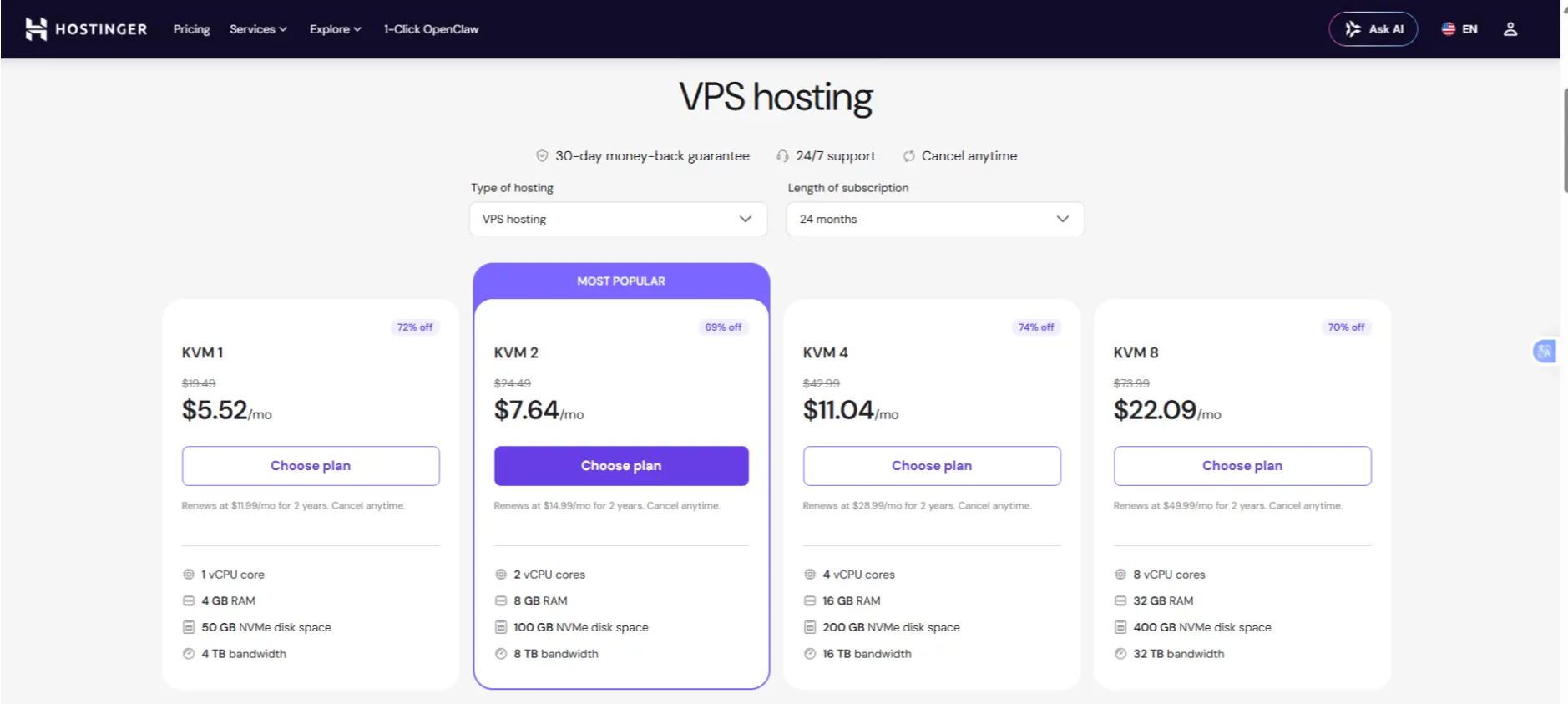
Hostinger is one of the best all-around VPS providers, combining strong performance, easy management, and competitive pricing.
Why It Fits Freelancers
Servers can be deployed quickly, and Hostinger’s custom hPanel makes VPS management less intimidating for beginners. At the same time, full root access gives experienced users complete control.
Pricing
Plans start at $5.52/month and include 1 vCPU, 4 GB RAM, 50 GB NVMe storage, and 4 TB bandwidth. Higher plans scale up to 8 vCPUs, 32 GB RAM, and 400 GB NVMe storage.
Key Specs
- NVMe SSD storage
- AMD EPYC processors
- Full root access
- Globally distributed data centres
- Custom hPanel
Ideal For
Freelancers looking for affordable VPS hosting that balances performance, ease of use, and scalability.
3) ScalaHosting
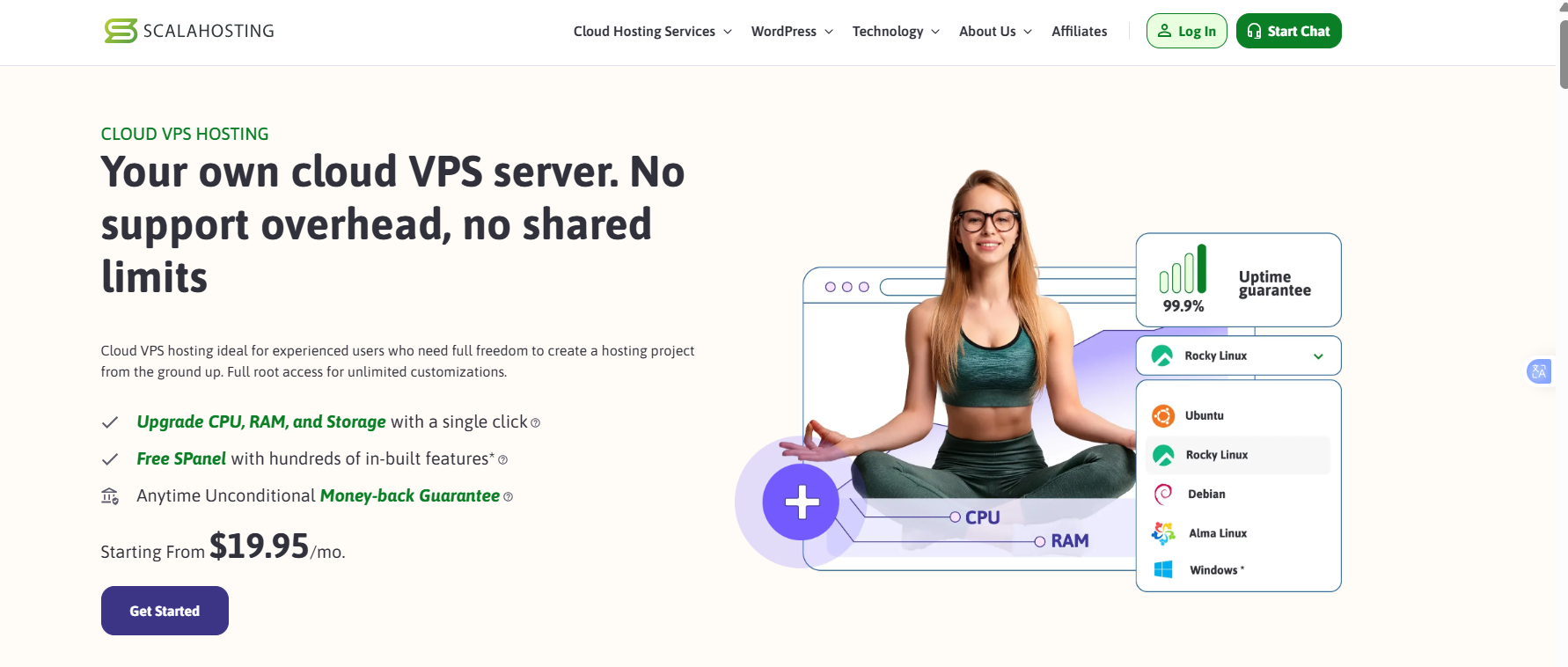
ScalaHosting is a popular choice for freelancers who want VPS performance without handling server administration themselves.
Why It Fits Freelancers
Its fully managed VPS plans handle server maintenance, updates, backups, and security, allowing you to focus on client work instead of technical tasks.
Standout Security
ScalaHosting’s SShield Security system provides real-time protection against malware, hacking attempts, and other threats, helping keep client websites secure.
Control Panel
Every managed VPS includes SPanel, a user-friendly alternative to cPanel that simplifies website, email, and server management.
Ideal For
Freelancers who want a hands-off hosting experience with strong security and managed support.
4) DigitalOcean (Droplets)

DigitalOcean remains a favourite among developers thanks to its simplicity, flexibility, and extensive learning resources.
Why It Fits Freelancers
Its huge library of tutorials and active community make it easier to learn server management and troubleshoot issues when they arise.
Pricing
Droplets start at $4/month with 1 vCPU, 1 GB RAM, and 25 GB SSD storage, with flexible scaling as projects grow.
Key Features
- 60-second server deployment
- Automated backups
- Monitoring dashboards
- Managed Kubernetes
- Powerful API
Ideal For
Developers, indie builders, and technical freelancers creating websites, applications, or custom client environments.
5) Vultr
Vultr stands out for its extensive global infrastructure, making it a strong choice for freelancers with international clients.
Why It Fits Freelancers
With over 30 server locations worldwide, Vultr allows you to deploy websites and applications closer to your clients and their audiences.
Key Features
- Global data centre network
- Fast VPS deployment
- Flexible compute options
- Pay-as-you-go pricing
Performance Edge
For the best results, choose Vultr’s High Frequency instances. They offer significantly better CPU performance than standard plans and are worth the upgrade for demanding workloads.
Ideal For
Freelancers and agencies serving clients across multiple countries or regions.
6) InMotion Hosting VPS
InMotion Hosting is designed for users managing multiple websites and client projects from a single hosting environment.
Why It Fits Freelancers
Many VPS plans support multiple websites and domains, making it easier to manage several client projects without juggling separate hosting accounts.
Key Features
- Launch Assist migration services
- cPanel access
- 24/7 support
- Resource monitoring tools
- Money-back guarantee
Ideal For
Freelancers and small agencies hosting multiple client websites who want a reliable, easy-to-manage VPS platform.
What Freelancers Should Look for in a VPS Host
With dozens of VPS providers on the market, it helps to have a clear framework for evaluation. Here are the six factors that matter most when you are choosing a VPS as a freelancer.
i) Performance and Speed
Server performance directly affects your clients’ user experience, your SEO rankings, and your own productivity as a developer.
When evaluating performance, pay attention to storage type (NVMe SSD is faster than standard SSD, which is faster than spinning disk), CPU architecture (modern AMD EPYC and Intel Xeon processors outperform older generations), and network infrastructure.
Look for providers that publish benchmark data and have a track record of consistent uptime rather than just impressive specifications on a sales page.
Geographic proximity to your audience matters enormously. A server in Frankfurt will serve a user in Berlin faster than one in New York, regardless of the underlying hardware. Choose a data centre location that matches where your visitors are concentrated.
ii) Pricing and Value
VPS pricing is notoriously opaque. The advertised price is often a promotional rate that requires a two-year or three-year commitment, and renewal rates can be significantly higher. Read the fine print on every plan before committing.
Beyond headline price, calculate value in terms of resources per dollar. A plan at $10 per month with 4 GB RAM and 80 GB NVMe SSD is better value than a $8 per month plan with 2 GB RAM and 40 GB standard SSD, even if the second plan looks cheaper at first glance. Also account for what is included: some providers charge extra for backups, SSL certificates, or control panel licences that others include for free.
iii) Ease of Use
VPS hosting, by its nature, requires more hands-on management than shared hosting. The question is how much more. Managed VPS providers handle the heavy lifting for you. Unmanaged providers give you a server and expect you to know what to do with it.
If you are comfortable with Linux, SSH, and basic server security, an unmanaged plan is fine. If not, choose a provider with a good control panel, solid onboarding documentation, and responsive support. The hours you save not fighting a server configuration problem are hours you can bill to clients.
iv) Scalability
Freelance workloads are unpredictable. A single viral post or a new high-profile client contract can double your traffic overnight. Choose a VPS provider that makes it easy to scale resources up, and scale them back down again once the spike passes.
Providers that require you to migrate to a new plan when upgrading, rather than adding resources to your existing instance, create unnecessary downtime and complexity.
Also consider whether the provider supports vertical scaling (adding more RAM and CPU to an existing server) and horizontal scaling (adding more servers to distribute load), especially if you anticipate significant growth.
v) Support and Reliability
When something breaks at an inconvenient time, and it will, you want help that is actually helpful. Look for providers offering 24/7 support through multiple channels, with response times measured in minutes, not hours. Read independent reviews rather than relying on testimonials on the provider’s own website.
Uptime guarantees matter too, but the SLA is only as good as the compensation it offers when the provider fails to meet it. A 99.9% uptime guarantee means up to 8.7 hours of potential downtime per year; 99.99% means less than an hour. For mission-critical client sites, that distinction is significant.
vi) Security Features
A compromised server is a professional catastrophe. At minimum, your VPS provider should offer DDoS protection, firewall configuration tools, and easy SSL certificate installation. Providers that include automated malware scanning, intrusion detection, and regular security patches as part of a managed offering are worth the premium if security is a concern.
Also consider your own security practices: always enable two-factor authentication on your hosting account, use SSH keys rather than passwords for server access, and keep your software stack up to date. The best provider-side security in the world cannot compensate for a weak password on your control panel.
Managed vs. Unmanaged VPS: Which Should Freelancers Choose?
This is one of the biggest decisions you’ll make when choosing a VPS. The right option depends on your technical skills, budget, and how much time you’re willing to spend managing a server.
Managed VPS Hosting
With a managed VPS, the hosting provider handles most of the technical work for you, including:
- Server setup and configuration
- Operating system and software updates
- Security monitoring and patches
- Automated backups
- Performance maintenance and troubleshooting
Providers like ScalaHosting are built around this approach, allowing freelancers to focus on client work instead of server administration.
Best for:
- Designers and marketers
- Content creators and consultants
- Freelancers with limited server experience
- Anyone who values convenience over complete control
The main downside is cost. Managed VPS plans are usually more expensive, but many freelancers find the time savings well worth the extra investment.
Unmanaged VPS Hosting
With an unmanaged VPS, you’re responsible for managing the server yourself.
This includes:
- Initial server setup
- Installing software and applications
- Configuring firewalls and security settings
- Managing updates and backups
- Monitoring performance and uptime
- Troubleshooting issues
Providers such as Hostinger, DigitalOcean, and Vultr primarily offer unmanaged VPS solutions.
Best for:
- Developers and technical users
- Freelancers comfortable with Linux and SSH
- Users who want maximum flexibility and control
- Those looking to reduce hosting costs
The biggest advantage is lower pricing and complete customization. However, the responsibility for maintaining the server falls entirely on you.
Risks of Unmanaged VPS
Before choosing an unmanaged VPS, keep these risks in mind:
- Missing security updates can expose your server to attacks
- Misconfigured settings can cause downtime
- Poor backup practices can lead to data loss
- Troubleshooting issues often requires technical expertise
For many freelancers, a managed VPS offers the best balance between convenience and reliability. If you’re unsure which option to choose, starting with a managed plan is often the safer route. You can always move to an unmanaged VPS later as your technical skills and confidence grow.
Which VPS Hosting Provider Is Best for You?
The best VPS depends on your needs.
TrueHost is a great choice for freelancers serving African clients thanks to its local infrastructure, affordable pricing, and convenient payment options like M-Pesa.
Hostinger offers one of the best combinations of performance, features, and value.
ScalaHosting is ideal for those who prefer fully managed hosting.
DigitalOcean suits developers who want flexibility and strong learning resources.
Vultr excels for freelancers with clients spread across multiple regions.
InMotion Hosting works well for managing multiple client websites from one VPS
The good news is that VPS hosting scales with your business, so you can start small and upgrade as your workload grows.
If your clients are in Africa, TrueHost VPS is one of the strongest options available. It combines reliable performance, local support, flexible payment methods, and pricing designed for freelancers and growing agencies.