 Domain SearchInstantly check and register your preferred domain name
 Web Hosting
 cPanel HostingHosting powered by cPanel (Most user friendly)
 WordPress HostingHost your WordPress website with fast, secure, and affordable WordPress hosting in Kenya.
 KE Domains
 Reseller HostingStart your own hosting business without tech hustles
 Windows HostingOptimized for Windows-based applications and sites.
 Free Domain
 Affiliate ProgramEarn commissions by referring customers to our platforms
 Free HostingTest our SSD Hosting for free, for life (1GB storage)
 Domain TransferMove your domain to us with zero downtime and full control
 All DomainsBrowse and register domain extensions from around the world
 .Com Domain
 WhoisLook up domain ownership, expiry dates, and registrar information
 VPS Hosting
 Managed VPSNon techy? Opt for fully managed VPS server
 Dedicated ServersEnjoy unmatched power and control with your own physical server.
 Website Builder
 Online Store BuilderLaunch a professional e-commerce store without writing code.
 Web Design ServiceGet a custom-designed website tailored to your brand and goals. From just KES 15,600
 BlogRead our guides on web hosting, online business, digital marketing, and more
 SupportOur support guides cover everything you need to know about our services
 ContactContact us via chat or email
No. Your domain name and registered business name do not have to match exactly in Kenya.
A company called Mwangaza Interiors Limited can use mwangazainteriors.co.ke.
It can also use a shorter brand domain such as mwangazahome.co.ke if that name fits its public identity and does not violate another party’s rights.
The two names come from separate systems:
The Business Registration Service records companies and business names.
A domain registry records internet addresses through domain registrars.
The Kenya Industrial Property Institute handles trademark registration.
Approval in one system does not automatically reserve the name in the others. Registering a business name does not secure the matching .co.ke or .com.
Buying a domain does not register a business or give you automatic trade mark rights.
The useful goal is not a character-for-character match. It is a clear, defensible connection between the name customers know, the entity behind it and the address they type.
A business name and a domain name perform different jobs
Question | Business or company name | Domain name |
|---|---|---|
What is it? | The registered name or trading style under which the business operates | The internet address used for a website, email or another online service |
Who records it? | Business Registration Service through the Companies Registry | The relevant domain registry through a registrar; KeNIC manages the |
What does approval give you? | A registration or incorporation record for the approved name and entity type | The right to use the registered address for its paid term, subject to registry and registrar rules |
Must it contain spaces? | It may contain spaces and an entity suffix such as | It cannot contain spaces and normally drops legal suffixes |
Does it create trade mark rights automatically? | No | No |
Does it reserve the other name? | No automatic domain reservation | No automatic company or business-name registration |
Does it require renewal? | Requirements depend on the registered entity and filings | The domain requires renewal to remain registered |
These differences make some variation normal. A domain cannot reproduce spaces, punctuation or every legal suffix exactly. Customers also benefit from a shorter address than the full name on an incorporation certificate.
Kenya does not require a character-for-character match
The Registration of Business Names Act defines a business name as the name or style under which someone carries on a business. Section 4 includes a corporation operating under a business name other than its corporate name among the parties that must register under the Act, subject to its terms and exceptions.
That matters when one company owns a separate customer-facing brand.
Suppose Eastland Ventures Limited launches a furniture brand called Mwangaza Home.
It may market the brand through mwangazahome.co.ke, but the company should not assume that its incorporation certificate automatically covers the separate trading name.
It should confirm the correct BRS registration and disclosure requirements for the structure it uses.
The domain does not have to reproduce Eastland Ventures Limited. It should represent the brand honestly and make the legal operator clear where customers, suppliers, banks and authorities need that information.
This article gives general naming guidance, not legal advice. A business with several trading names, regulated activities, investors or an active name dispute should obtain advice on its specific structure.
You may have four different names to check
Founders often treat “the name” as one decision. In practice, a Kenyan business may need to coordinate four assets.
a) The legal entity name
This is the incorporated company’s name, such as Mwangaza Interiors Limited.
The Companies Act requires a private limited company’s name to end in Limited or Ltd, unless an exemption applies.
It also prevents the Registrar of companies from registering the same name as another name in the company-name index, subject to the Act and regulations.
Your public domain will normally omit Limited or Ltd because the suffix makes the address longer without helping customers find the brand.
b) The registered business name
A business name is the trading style under which an individual, firm or corporation carries on business.
The Business Registration Service says a business name is not a separate legal entity.
A sole proprietor using a registered business name remains the person behind that business; the registration does not create a limited company.
c) The trade mark
A trade mark can protect a distinctive name, logo, slogan or other mark for relevant goods or services.
KIPI says registration provides direct evidence of exclusive ownership in Kenya. Trade mark protection has its own search, application, classification and review process.
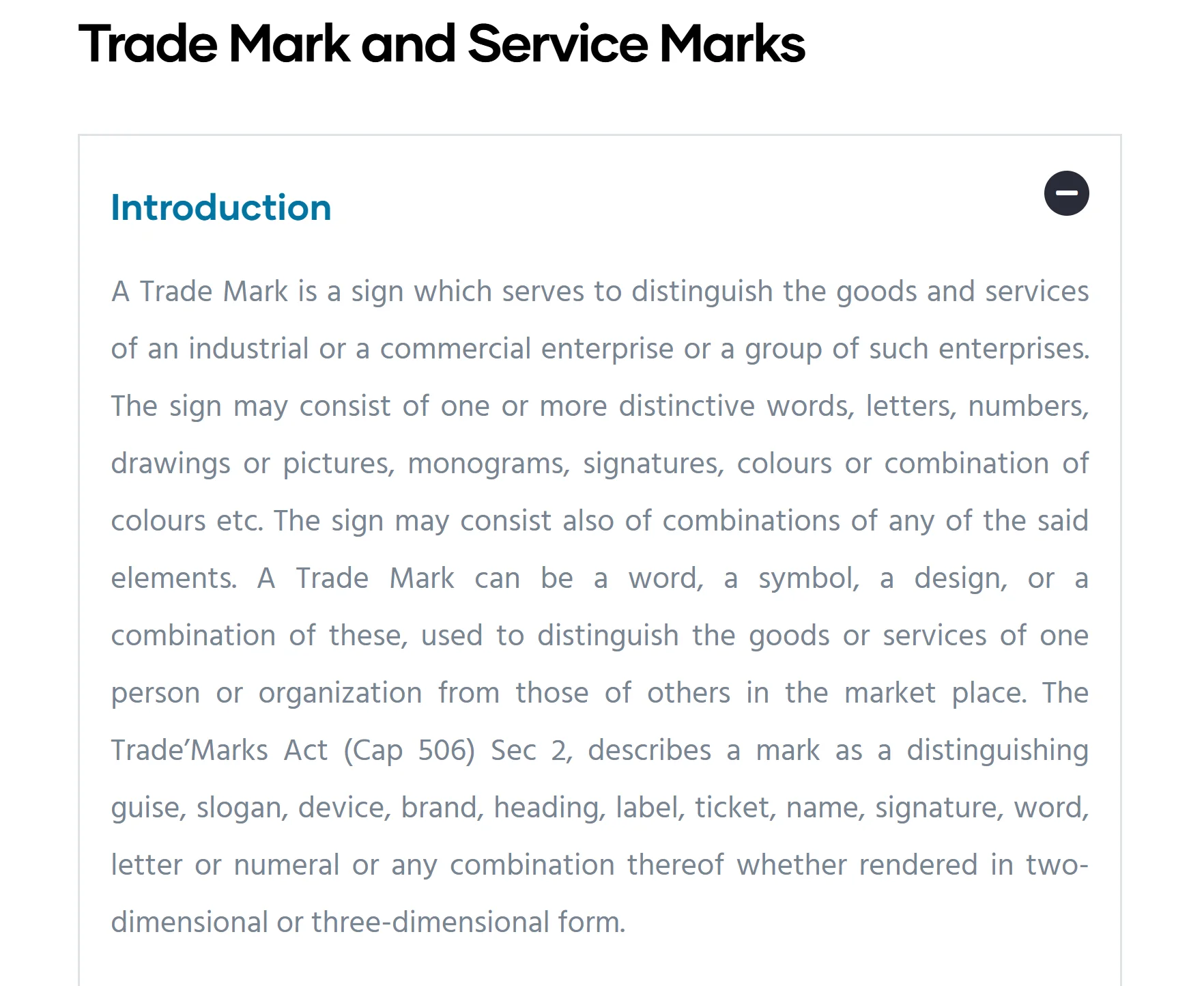
A BRS approval is not a substitute for a KIPI search.
BRS itself warns that a proposed company name should not be the same as or similar to a registered trade mark and recommends a trade mark search where appropriate.
d) The domain name
The domain is the address, such as mwangazainteriors.co.ke.
KeNIC’s .ke policy makes the registrant responsible for selecting a name and for possible violations of third-party rights.
A domain registration therefore does not certify that the name is legally safe.
If two parties claim rights in the same .ke address, KeNIC has an Alternate Domain Dispute Resolution process.
A domain dispute requires evidence; holding a BRS certificate does not guarantee an automatic domain transfer.
When an exact or near-exact match is the best option
Use the closest clean match when it is available, pronounceable and consistent with the brand customers see.
Customers can move between channels without guessing
If the shop sign says Mwangaza Interiors, mwangazainteriors.co.ke feels predictable. A customer can hear the name, search it and recognize the correct result.
The same consistency helps on quotations, packaging, social profiles and directory listings.
Business email looks connected to the sender
An address such as [email protected] reinforces the name on the proposal or invoice.
The domain does not need the legal suffix to make that connection. [email protected] is longer and easier to mistype without adding meaningful trust.
If email will become a major customer channel, review the business-email benefits and operating cases before deciding which domain will appear after the @ sign.
Staff can state the address without explaining a variation
A good domain survives the spoken test. Someone should be able to hear it once and type it correctly.
If matching the registered name creates a long string, repeated letters or confusing punctuation, a shorter brand-aligned version may work better than an exact match.
When a different domain is the better decision
Matching is useful only when the result remains clear.
The registered name contains a legal suffix
Drop Limited, Ltd, LLP and similar legal-form wording from the primary domain unless the suffix distinguishes the brand.
mwangazainteriors.co.ke is cleaner than mwangazainteriorslimited.co.ke.
The legal name is longer than the customer-facing brand
A parent company can own several products or trading brands.
Registered or legal name | Customer-facing name | Suitable domain approach |
|---|---|---|
Mwangaza Interiors Limited | Mwangaza Interiors |
|
Eastland Ventures Limited | Mwangaza Home |
|
Amina Njeri trading as Njeri Cakes | Njeri Cakes |
|
Green Ridge Agribusiness Limited | Green Ridge Fresh |
|
Nairobi Office Supplies Limited | NOS Office | A readable brand domain, not an unexplained initial string |
The public brand and legal operator should have a documented relationship. Make that relationship clear on contracts, invoices and the website rather than pretending the domain itself proves ownership.
The exact domain is unavailable
Do not add random numbers or multiple hyphens before checking better brand variations.
Try a relevant modifier:
shopmwangaza.co.ke;mwangazahome.co.ke;mwangazainteriors.ke; oranother domain extension that fits the intended audience.
Our guide to choosing a domain for a Kenyan business or brand covers length, clarity and extension decisions.
Use it after you establish which business or brand name the address should represent.
You, however, want to avoid a variation that looks like another company’s domain.
The business expects several brands
A neutral corporate domain can serve investor, legal or group communication while each trading brand uses its own customer domain.
For example:
eastlandventures.co.kefor the parent company;mwangazahome.co.kefor the furniture brand; andsokofresh.co.kefor a food-delivery brand.
That structure costs more to register and manage, but it can make each offer clearer than forcing unrelated products under one long corporate address.
A mismatch becomes a problem when customers cannot see the relationship
The issue is not that the strings differ. The issue is confusion.
The domain looks unrelated to the invoice or payment recipient
A buyer visits bestsofas.co.ke but receives a quotation from Eastland Ventures Limited.
Without an explanation, the change can look suspicious.
State that Best Sofas is a trading brand of Eastland Ventures Limited wherever the relationship affects a transaction. Use consistent contacts, branding and documentation.
Another business already uses the name
BRS approval, domain availability and trade mark clearance answer different questions.
A domain can be technically available while its use creates a conflict with another party’s name or mark. KeNIC tells registrants not to knowingly violate third-party intellectual-property rights.
Do not build a logo, website and advertising campaign before checking the name across all relevant systems.
The domain has a risky history
A previously registered domain can carry old backlinks, spam associations, copied content or a reputation you did not create.
Before buying an expired or previously used address, follow the checks in our domain-history guide. A perfect textual match is not valuable if the old domain creates avoidable trust or search problems.
One person controls the domain outside the business account
The founder, company or authorized organization should control the registrar account, recovery email, payment method and renewal process.
Do not leave the business address registered only in a developer’s, employee’s or agency’s personal account. The name on the BRS record will not automatically give you access to that account during a dispute.
Check the name across three systems before committing
A practical search should cover BRS, KIPI and the domain registry.
1) Prepare several credible names
BRS currently asks applicants to submit preferred names through its online registration process. Build a shortlist rather than betting every asset on one spelling.
Each option should:
fit the intended business activity;
remain distinctive as the business expands;
avoid misleading legal or regulated terms;
work when spoken;
produce a readable domain; and
leave room for a trade mark search.
2) Check BRS requirements and existing registrations
The BRS Companies Registry administers company, business-name and LLP registrations. Its naming guidance rejects identical registered names and warns about similarity to registered trade marks.
BRS states that name reservation and registration now happen in one online process through eCitizen. Use the current BRS instructions rather than an older tutorial that treats name search as a separate application.
3) Search relevant trade marks
Search KIPI records for identical and confusingly similar marks in the classes connected to your goods or services.
A simple web search is not a trade mark clearance search. KIPI’s process and fees can change, so confirm the current procedure directly with KIPI or a qualified trade mark professional.
4) Check domain availability across the extensions you may use
Search the clean brand spelling under .co.ke, .ke, .com and any industry extension that genuinely fits.
Use our live Kenya domain search to compare current availability and registration terms. Do not rely on a search-engine result or an old screenshot because another person can register an available name at any time.
5) Review history and obvious conflicts
Check:
earlier versions of the website;
current search results for the name;
social-media use;
marketplace and directory listings;
confusingly similar domains;
previous ownership signals; and
visible trade mark conflicts.
This review does not replace professional clearance, but it can eliminate weak options before you spend more.
Should you register the domain before the business name?
There is no risk-free universal order because the two systems do not reserve names for each other.
If you register the domain first, BRS may reject the proposed business or company name. You will then own an address that no longer fits the approved name.
If you wait until registration finishes, another buyer could take the domain.
Use this balanced sequence:
Develop three to five viable names.
Check BRS naming rules and obvious existing registrations.
Check relevant KIPI records.
Check the matching domains and their history.
Submit the strongest names through BRS.
Register the domain promptly after approval.
For a high-value launch, you may choose to register the strongest affordable domain candidates earlier and accept that a rejected name could leave you with an unused registration. That is a budget decision, not a guarantee of BRS approval.
Never present domain ownership as evidence that BRS must approve the business name.
Protect the primary name without registering every variation
One strong domain should carry the website and email. Extra registrations should solve a specific risk.
Consider a second domain when it:
protects the matching
.comor.co.ke;catches a common spelling error;
supports a documented rebrand;
prevents confusion between a parent and product brand; or
redirects an old name after a change.
Our guide to registering multiple domains for a Kenyan business helps distinguish useful protection from an expensive collection of names.
Redirect secondary domains to the primary address. Do not publish duplicate websites across several domains without a technical and search plan.
Turn the chosen domain into a business asset
Registration is only the first step.
Put the domain in an account the business controls. Enable multifactor authentication and registrar lock. Record the renewal owner, recovery address and handover procedure.
Then connect it to the services customers will use:
the main website;
professional email;
redirects from secondary domains;
verification records; and
selected business profiles.
Use our post-registration domain checklist to move from ownership to working DNS, security and renewal controls. When you are ready to publish, the Kenya business-website guide covers the next build decisions.
The names do not need to match, but the business must make sense
Your legal name, business name, trade mark and domain can differ. Each exists for a different reason.
The strongest setup usually keeps them close enough that a customer can understand the relationship:
the legal entity owns or operates the brand;
the brand appears consistently in public;
the domain is short and recognizable;
trade mark and registry checks reveal no obvious conflict; and
the business controls the registrar account.
Choose the business identity first, then secure the clearest defensible address around it.
When your shortlist is ready, check the matching .co.ke, .ke, .com and other available domains with Truehost.
Register the primary name in a business-controlled account and document who manages it.