 Domain SearchInstantly check and register your preferred domain name
 Web Hosting
 cPanel HostingHosting powered by cPanel (Most user friendly)
 WordPress HostingHost your WordPress website with fast, secure, and affordable WordPress hosting in Kenya.
 KE Domains
 Reseller HostingStart your own hosting business without tech hustles
 Windows HostingOptimized for Windows-based applications and sites.
 Free Domain
 Affiliate ProgramEarn commissions by referring customers to our platforms
 Free HostingTest our SSD Hosting for free, for life (1GB storage)
 Domain TransferMove your domain to us with zero downtime and full control
 All DomainsBrowse and register domain extensions from around the world
 .Com Domain
 WhoisLook up domain ownership, expiry dates, and registrar information
 VPS Hosting
 Managed VPSNon techy? Opt for fully managed VPS server
 Dedicated ServersEnjoy unmatched power and control with your own physical server.
 Website Builder
 Online Store BuilderLaunch a professional e-commerce store without writing code.
 Web Design ServiceGet a custom-designed website tailored to your brand and goals. From just KES 15,600
 BlogRead our guides on web hosting, online business, digital marketing, and more
 SupportOur support guides cover everything you need to know about our services
 ContactContact us via chat or email
The fastest way to mess up your business with AI content is to remove the people who know what is true, useful and safe to publish.
A writing tool can turn a brief into a draft quickly. It can also invent a source, reuse a tired claim, expose customer information or produce 50 pages that answer no real question. The tool does not carry the commercial consequences. Your business does.
This is not an argument against AI-assisted work. Google does not ban content because AI helped create it.
Kenya’s data-protection regulator does not prohibit generative AI either. The problem starts when speed replaces evidence, judgement and accountability.
Here are the failure modes that can turn a cheap publishing shortcut into expensive repair work.
1) Publish claims that nobody verified
Generative AI predicts plausible output.
It does not guarantee that a price, quotation, product feature, law, address or citation is correct.
NIST calls confidently produced false or erroneous content confabulation and recommends reviewing sources and citations in generated output.
Risky content rarely looks obviously absurd. It may contain a believable statistic with no traceable dataset, attribute a statement to the wrong person or describe a feature that a supplier removed months ago.
A fluent paragraph can lower an editor’s guard precisely because it looks finished.
Errors become more serious when they affect a buying decision.
Kenya’s Consumer Protection Act treats false, misleading or deceptive representations as unfair practices.
It specifically covers claims about a product’s qualities, benefits, approval, availability and price advantage.
Before publication, trace every consequential claim to a current source. Check the actual page, document or internal record. Do not ask the same AI system whether its first answer was correct and count that as verification.
2) Let AI invent your offer
An empty prompt such as “write a persuasive landing page” invites the model to fill missing business facts with familiar marketing patterns.
The result may promise same-day delivery, 24-hour support, a money-back guarantee, nationwide coverage or “the lowest price” even when none of those terms appear in the approved offer.
That copy is not harmless decoration. Customers may rely on it before paying or contacting your team.
Sales and support staff then inherit a promise they never approved.
Give the tool a controlled fact pack instead:
the exact product and audience;
approved features and exclusions;
current price source or dynamic-price field;
delivery area and timeframe;
support hours;
warranty or refund terms; and
claims that the draft must not make.
If a fact is missing, the draft should mark a question for the owner rather than manufacture an answer. “Confirm delivery radius” is useful editorial output. “We deliver everywhere in Kenya” is a liability when it is merely a guess.
3) Feed customer or company secrets into the prompt
Teams often paste more than they need into a writing tool: customer emails, support tickets, contracts, medical details, employee records, unreleased prices or confidential proposals.
The draft may then repeat personal or proprietary information in an output, log or shared workspace.
Kenya’s July 2026 ODPC guidance says organisations using generative AI systems that process personal data must comply with the Data Protection Act and related regulations.
It calls for a lawful basis, data minimisation, safeguards against leakage and inaccurate personal information, transparency, human review and remedies for affected people.
Create an approved-use policy before staff use AI for content. It should identify permitted tools, prohibited data, retention settings, responsible reviewers and the incident path if a prompt or output exposes sensitive information.
For ordinary drafting, remove names, phone numbers, account identifiers and unique case details. Replace them with neutral placeholders.
If the content genuinely needs personal data, involve the organisation’s data-protection lead and use a system approved for that purpose.
4) Flood your website with pages made for search engines
Publishing more URLs is not the same as building more value.
A business can generate hundreds of location pages, product variations and question pages that repeat the same answer with different nouns.
The pages compete for crawling, internal links and maintenance while giving readers little reason to choose one over another.
Google’s current AI guidance says generative AI can help with research and structure. It also warns that generating many pages without adding user value may violate the scaled-content-abuse policy.
The policy applies regardless of whether the low-value pages came from AI, scraping or another process.
Do not solve one weak page by ordering 100 more. Start with the customer’s real task. Decide which URL should own it, what first-hand evidence you can add and which existing page needs an update instead of a competitor.
The right production measure is not “articles published this week.” Track qualified visits, useful enquiries, assisted sales, corrections, support questions and pages that remain accurate after three or six months.
5) Remove every sign that your business knows the customer
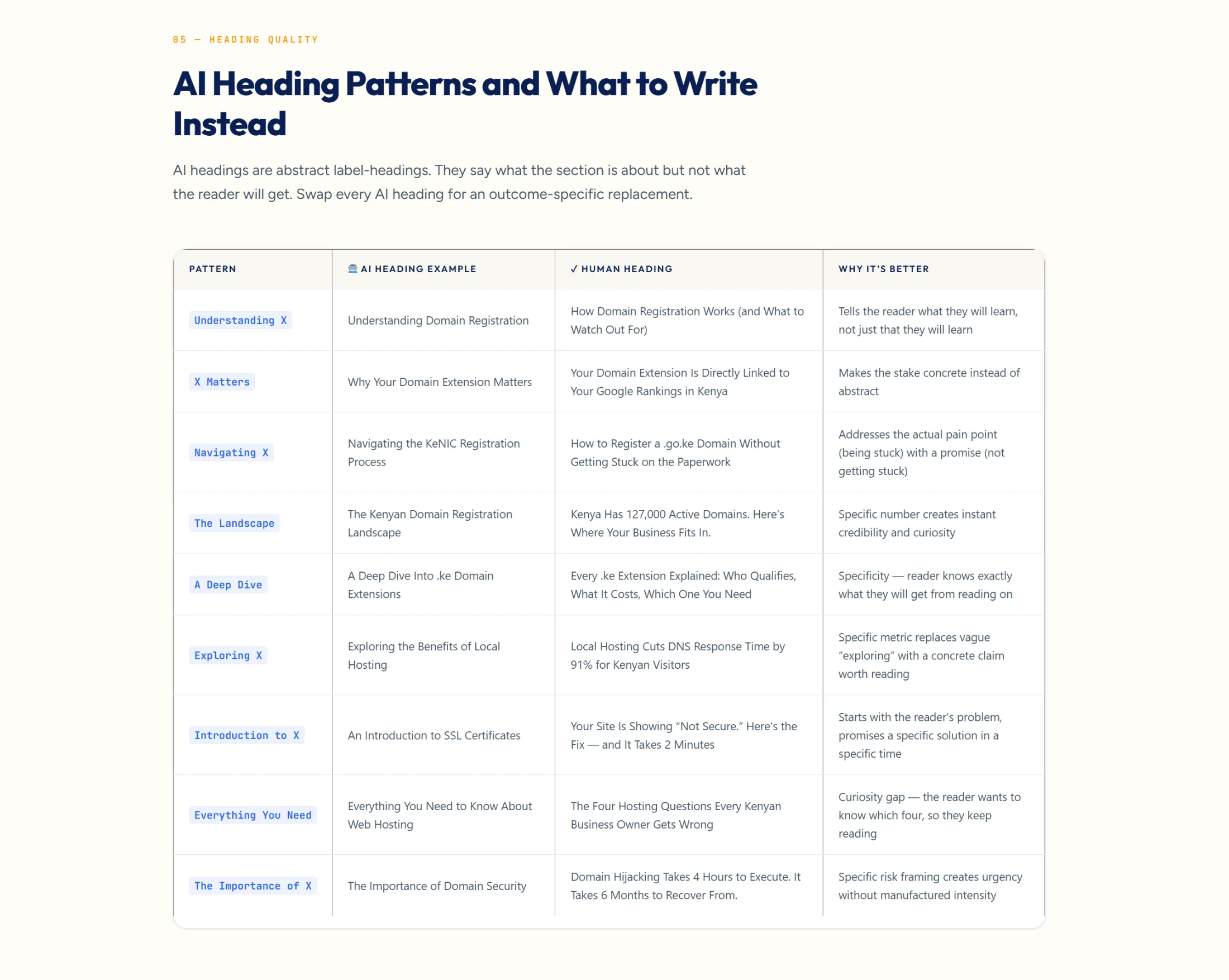
Default AI copy often sounds competent but interchangeable. It can describe a Nairobi restaurant, a Canadian software firm and a Mombasa tour operator with the same adjectives, examples and rhythm.
That flattening makes the business harder to remember.
Local relevance is not achieved by inserting “Kenya” into every heading.
It comes from real operating detail: where delivery stops, how M-Pesa confirmation works, which documents a customer needs, what happens after an order and who handles a problem.
Build those details from interviews, support logs, product demonstrations and staff knowledge.
Then use AI to organise or test the explanation. If the tool supplies the experience as well as the sentences, the page may sound polished while teaching the reader nothing your team actually knows.
Our AI slop guide helps editors remove predictable phrases and structures.
That edit is important, but replacing a few overused words cannot repair a draft with no evidence or original experience.
6) Reproduce work you do not have permission to use
A generated paragraph or image does not arrive with a universal commercial licence covering every source that may have influenced it.
Content can echo a competitor’s wording, reproduce protected material supplied in the prompt or create a close imitation of a recognisable creative work.
KECOBO guidance explains that copyright rules still apply in the digital environment, including reproduction and distribution.
Separate guidance also stresses proper acknowledgement when limited use depends on fair dealing.
Do not use AI as a laundering step for material you could not otherwise publish.
Keep records for source text, photographs, illustrations, music and commissioned work. Review the tool’s terms, your supplier agreement and the rights attached to every input asset.
For a high-value campaign or a close stylistic imitation, obtain legal review rather than guessing.
You should also preserve the human contribution to important work: the brief, interview notes, original photographs, edits, approvals and final source files. That record helps establish provenance and makes later corrections possible.
7) Automate sensitive decisions inside ordinary content
A chatbot draft can quietly shift from communication into decision-making.
It may, for instance:
rank applicants,
label a customer as fraudulent,
suggest medical action,
assess creditworthiness or
personalise an offer using inferred personal traits.
Those uses carry more risk than rewriting a product description. The ODPC guidance calls for meaningful human oversight of automated decisions and for staff to have the authority, competence and information needed to review contested outcomes.
Set a clear boundary. A content assistant may summarise approved information, propose headings or simplify a policy.
It should not make or disguise a consequential decision unless the organisation has designed, assessed and governed that system for the specific use.
Human review must be real. A junior editor who cannot see the source data, challenge the result or stop publication is not an effective safeguard.
8) Hide how you produced the content when disclosure is important
Not every AI-assisted sentence needs a label. Spell-checking, transcription and outline support may not change what a reasonable reader needs to know.
Disclosure becomes more important when readers could mistake synthetic content for a real customer, real event, professional opinion or independently tested result.
Google’s people-first guidance recommends considering disclosure when someone would reasonably ask how creators used substantial automation.
The ODPC also calls for accessible information where readers may mistake AI-generated material for solely human content or where it may materially affect a person’s rights or interests.
Ask what the reader needs to interpret the material fairly. A generated product lifestyle image should not imply a documented customer experience.
Never present a synthetic testimonial as a real buyer’s words. An AI summary of legal or medical information still needs qualified review and clear limits.
Disclosure does not cure an inaccurate or deceptive claim. It adds context; it does not transfer responsibility away from the publisher.
9) Publish faster than you can correct
AI reduces the cost of producing a draft, but it can increase the number of pages, channels and factual claims your team must maintain.
If nobody owns each published asset, outdated offers and repeated errors spread across blog posts, email sequences, product pages and social accounts.
Every important page needs an accountable owner, source record, approval date and review trigger.
A price change should trigger every affected page. A corrected policy should not remain contradicted by a chatbot answer or scheduled email.
At Dowebsites, I built a system that makes pricing mentions dynamic and updates every week. By using shortcodes, for instance, I never need to touch the pages just to update prices, as I can just run a task that fetches current prices.
I was able to have this hindsight because of years of working with and maintaining hundreds of pages a month.
Make correction easy for customers and staff. Record what changed, remove unsafe variants and investigate why the review failed. Quietly fixing one sentence without repairing the workflow allows the same problem to return.
A safer AI content workflow
You do not need to choose between typing everything manually and publishing raw machine output.
Use AI where it reduces repetitive work, then place human judgement at the points where the business carries risk.
Stage | AI can help with | A person must own |
|---|---|---|
Brief | Group questions and propose structure | Audience, purpose, offer and prohibited claims |
Evidence | Summarise supplied material | Source selection, currency and factual accuracy |
Draft | Produce alternatives and simplify language | Business voice, local detail and original insight |
Risk review | Flag possible names, numbers and promises | Privacy, legal, sector and reputational decisions |
Publication | Format metadata and check links | Final approval, disclosure and accountability |
Maintenance | Identify stale dates or inconsistent copy | Corrections, incident response and page retirement |
For a normal business article, the working sequence is:
Write the reader’s question and the intended business outcome.
Assemble approved sources, original examples and product facts.
Remove personal and confidential data from the prompt.
Ask for a draft with explicit uncertainty markers.
Verify every claim that could affect money, safety, rights or reputation.
Add first-hand detail from the people who do the work.
Edit for clarity, brand voice and Kenyan context.
Run privacy, rights and sector checks where needed.
Assign a named approver and future review date.
Measure reader and business outcomes, not output volume.
NIST’s AI risk profile supports this governance approach: define acceptable use, assess vendors, verify citations, protect personal information and preserve meaningful human oversight.
Use AI as an assistant, not an alibi
AI can make a capable team faster. It cannot decide which promise your business can keep, whether customer data belongs in a prompt or whether a confident claim is true.
The businesses most likely to suffer are not necessarily those using the newest tools. They are the ones publishing without a source trail, responsible owner or way to stop an unsafe draft.
Start by auditing what is already live. Remove unsupported claims, consolidate repeated pages and assign ownership to the content that customers rely on. Our content audit provides a practical next step for finding weak and outdated pages before generating anything new.