 Domain SearchInstantly check and register your preferred domain name
 Web Hosting
 cPanel HostingHosting powered by cPanel (Most user friendly)
 WordPress HostingHost your WordPress website with fast, secure, and affordable WordPress hosting in Kenya.
 KE Domains
 Reseller HostingStart your own hosting business without tech hustles
 Windows HostingOptimized for Windows-based applications and sites.
 Free Domain
 Affiliate ProgramEarn commissions by referring customers to our platforms
 Free HostingTest our SSD Hosting for free, for life (1GB storage)
 Domain TransferMove your domain to us with zero downtime and full control
 All DomainsBrowse and register domain extensions from around the world
 .Com Domain
 WhoisLook up domain ownership, expiry dates, and registrar information
 VPS Hosting
 Managed VPSNon techy? Opt for fully managed VPS server
 Dedicated ServersEnjoy unmatched power and control with your own physical server.
 Website Builder
 Online Store BuilderLaunch a professional e-commerce store without writing code.
 Web Design ServiceGet a custom-designed website tailored to your brand and goals. From just KES 15,600
 BlogRead our guides on web hosting, online business, digital marketing, and more
 SupportOur support guides cover everything you need to know about our services
 ContactContact us via chat or email
You have probably seen .net at the end of a web address before. Maybe you have even wondered what it stands for or if you should register one for yourself.
A .net domain is a top-level domain, or TLD. The name comes from the word “network.” Back when it was first created, it was meant for internet service providers and networking companies.
But things have changed since then. A lot.
In this article, we’ll talk about .net domains. You will learn the history of this extension, who manages it today, and how people use it.
Plus, I will also show you what .net costs in Kenya, what you need to register for one, and the real advantages and disadvantages of choosing .net over other options.
Brief History of .net Domain
The .net domain launched in 1985 as one of the original top-level domains, right alongside .com, .org, .edu, .gov, and .mil. These were the first extensions ever created for the internet.
The original purpose of .net was was for network-focused organizations. For example, internet service providers and companies that built the internet’s backbone infrastructure.
If you were running the cables and servers that made the internet work, .net was for you.
Over time, those restrictions went away. Today, anyone can register a .net domain for any purpose. There are no special requirements or approvals needed.
Currently, Verisign operates the .net domain. Verisign is a global leader in domain registry services.

They manage the domain under an agreement with ICANN, the organization that coordinates unique identifiers across the internet. This arrangement helps keep the domain stable and secure.
What Is .net Domain Used For? The Main Uses Today
Now that you know the history and meaning of .net, let’s see how people use it today. The .net domain serves many different purposes, and some of them are:
1) Technology and Software Companies
Technology companies and software businesses naturally lean toward .net. Because .net has a strong connection to networking and technology, many tech companies choose it on purpose.
They want to show that they are a technical or internet-related business.
Software development firms, cloud computing providers, cybersecurity companies, and digital infrastructure businesses mostly pick .net.
When a company has a .net domain, visitors get the impression that the business is a pro with technology
2) Internet Service Providers (ISPs)
This is the most historically accurate use of .net. Internet service providers, the companies that give you internet access at home or work, fit perfectly with .net. These companies are the backbone of internet networking.
Many ISPs and telecommunications companies worldwide use .net for their main websites and customer portals.
If your internet provider ever gave you an email address ending in .net, that reflects this original networking identity.
3) Networking and Infrastructure Organizations
Besides ISPs, .net is used by organizations that manage or develop internet infrastructure. This includes:
- Domain registrars
- Web hosting companies
- Content delivery networks
- Server management firms
- Network hardware manufacturers.
These organizations feel at home with .net because it matches the original intent of the extension.
4) Alternative to .com When the Desired Name Is Taken
Let’s say you have a great name in mind for your business or project. You go to register it, only to find that someone already took the .com version.
This happens all the time because .com is the most popular domain extension worldwide. Almost every short, catchy, and memorable .com name has already been registered by someone.
So what do you do? Many people turn to .net as their next choice. It is widely recognized. It carries a professional reputation.
And it is easy for your customers to remember. You do not have to explain what .net means. People already know it.
For example, you want to register the name “BrightCloud.” You check, and BrightCloud.com is gone. But BrightCloud.net is available. Registering it gives you a professional, credible web address that people will trust.
5) Developer Tools, APIs, and Open Source Projects
If you are a developer or someone who works with code, you have probably seen .net domains everywhere. They are popular in software development.
For instance, in programming frameworks, libraries, and developer tools. Many of them use .net for their official websites and documentation pages. The same goes for APIs and open source projects.
You have probably heard of the Microsoft .NET Framework. It is a major software development platform used by millions of programmers worldwide.
Microsoft chose the .net domain for that platform, making .net feel familiar for developers everywhere.
6) Online Communities and Forums
Online communities, discussion boards, and forums have also embraced .net over the years.
Back in the early days of the internet, many people were building fan sites, hobby forums, and interest groups. They wanted a domain name for their community.
But .com was either already taken or too expensive for them at the time. So they chose .net instead.
Over time, this made .net a familiar home for community-driven websites. People got used to seeing forums and fan sites on .net.
And that has not changed. Today, you still find many active online communities, gaming sites, fan wikis, and interest-based forums operating under .net domains.
7) E-commerce and Business Websites
Yes, .com is the traditional favorite for online stores. However, many businesses run successful e-commerce sites on .net domains.
How? If your website is well-designed, looks trustworthy, and provides a good customer experience, they will not care about the domain extension. They want their product delivered and their questions answered. That is it.
So today, small businesses, freelancers, and entrepreneurs who could not get their preferred .com name build thriving businesses on .net.
8) Personal Websites and Portfolios
Individuals use .net for personal websites, portfolios, and blogs, too.
Let us say you are a web designer, photographer, writer, or developer. You want to showcase your work online. You also want to look professional.
A .net domain does that job well. It gives your personal site a polished feel without costing you the premium price of an aftermarket .com name.
9) Non-Profit and Advocacy Organizations
You probably know that .org is the traditional choice for non-profits. But many non-profit organizations, charities, and advocacy groups also use .net.
This happens for two main reasons. First, the organization might have a technology or digital focus. In that case, .net actually makes more sense than .org.
Second, the .org version of their desired name might have been taken when they went to register. So they pick .net instead.
.net Domain Examples
These are some examples of real websites that use the .net TLD.

- Speedtest.net – A tool for checking internet connection speed. This aligns perfectly with the original networking intent of the domain.
- Behance.net – A portfolio platform for creatives, currently owned by Adobe.
- Slideshare.net – A professional website used for sharing presentations and documents.
- Threads.net – The official web address for Meta’s Threads social media application.
- NordU.net – Recognized historically as one of the earliest websites registered under the .net extension.
How Much is a .net Domain?
Prices for .net domains vary depending on which registrar you use. Here is a comparison of prices in Kenya:
| Registrar | Price (Ksh) | Notes |
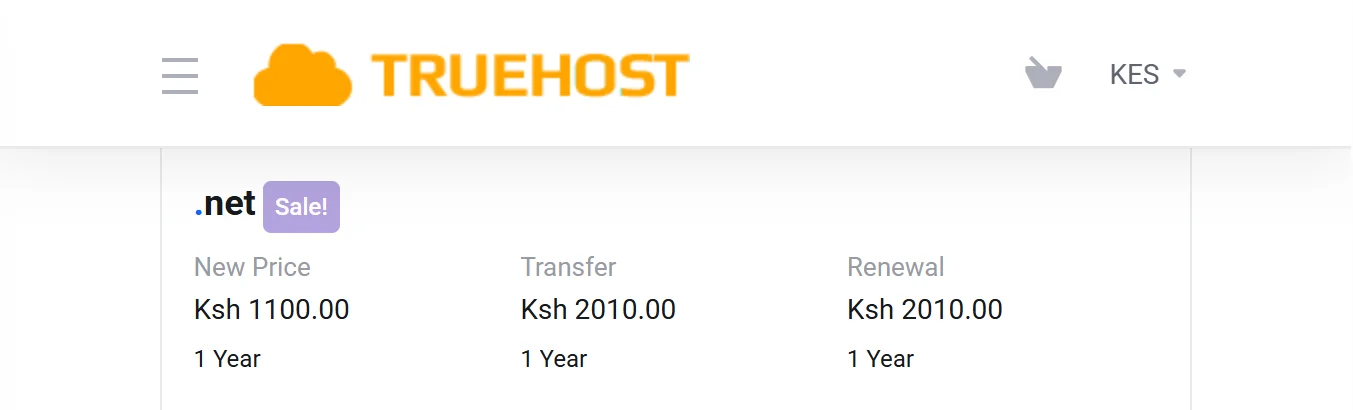
| Truehost | 1100 | Most affordable option |
| Hostafrica | 1868 | Mid-range pricing |
| Safaricom | 3070 | Premium pricing |
| Namecheap | 1687 | International registrar |
If you want the best value, Truehost offers the most competitive pricing for .net domains in Kenya.
We also provide local support, which makes a difference when you need help with your domain.
Requirements for .net Domain Registration
This is what you need to register a .net domain:
Choose an available domain name. Your name must meet standard guidelines. It can be between 1 and 63 characters long. You can use letters, numbers, and hyphens. No special characters are allowed.
Provide valid registrant contact information. You need your full name, email address, physical address, and phone number. This information goes into the public WHOIS database unless you purchase privacy protection.
Ensure the domain does not infringe on existing trademarks. You cannot register a name that belongs to someone else’s trademark, it could lead to a legal dispute.
Make payment. The minimum registration period is typically one year. You can register for up to ten years in advance.
Is .net Domain Worth It?
Pros
- Highly trusted and credible. The .net extension has been around since 1985. People recognize it and know it is legitimate.
- Better availability of good names. The .com space is very crowded. With .net, you have a much better chance of getting the name you actually want.
- Excellent for tech companies. If you run an ISP, hosting provider, or networking tool, .net fits your business perfectly.
- Familiar to users. People have been clicking .net links for decades. There is no hesitation or confusion when they see this extension.
Cons
- Less popular than .com. .com is still the default for most people. When someone hears a website name, they assume .com first.
- Potential confusion: some visitors might assume your site is a .com and type it instead. If someone else owns the .com version, you could lose traffic to them.
- Renewal rates can be higher. Compared to newer or niche TLDs, .net renewals are not always the cheapest option. Always check the renewal price before you buy.
Verdict
Register a .net domain if your preferred .com is already taken. Also register .net if your business operates in technology, networking, or infrastructure.
The extension offers strong credibility and wide recognition. Users feel comfortable clicking on .net links. For many people, it is the best alternative to .com.
Final Take on .net Domain
The .net domain has been on the internet for a while. It started as a special extension just for network providers and internet companies. Now? Anyone can use it. And millions of people do.
Today, .net is one of the most respected and useful domain extensions you can register. It has history. It has credibility.
And it works for tech companies, online communities, personal portfolios, and even e-commerce stores. If you need a professional web address and .com is unavailable, .net is an ideal alternative.
So, have you found a name you like? Go check if the .net version is available. If it is, grab it before someone else does.