 Domain SearchInstantly check and register your preferred domain name
 Web Hosting
 cPanel HostingHosting powered by cPanel (Most user friendly)
 WordPress HostingHost your WordPress website with fast, secure, and affordable WordPress hosting in Kenya.
 KE Domains
 Reseller HostingStart your own hosting business without tech hustles
 Windows HostingOptimized for Windows-based applications and sites.
 Free Domain
 Affiliate ProgramEarn commissions by referring customers to our platforms
 Free HostingTest our SSD Hosting for free, for life (1GB storage)
 Domain TransferMove your domain to us with zero downtime and full control
 All DomainsBrowse and register domain extensions from around the world
 .Com Domain
 WhoisLook up domain ownership, expiry dates, and registrar information
 VPS Hosting
 Managed VPSNon techy? Opt for fully managed VPS server
 Dedicated ServersEnjoy unmatched power and control with your own physical server.
 Website Builder
 Online Store BuilderLaunch a professional e-commerce store without writing code.
 Web Design ServiceGet a custom-designed website tailored to your brand and goals. From just KES 15,600
 BlogRead our guides on web hosting, online business, digital marketing, and more
 SupportOur support guides cover everything you need to know about our services
 ContactContact us via chat or email
For a new Kenyan business website, we recommend starting with .co.ke when you want a commercial address at a lower ongoing cost. Choose direct .ke when it gives you a cleaner brand name and the higher renewal cost fits your budget. Both identify your site with Kenya.
The choice changes if you already have a working website. A shorter address can be useful, but switching also affects your links, email addresses and the name customers already use.
.co.ke and .ke sit at different levels
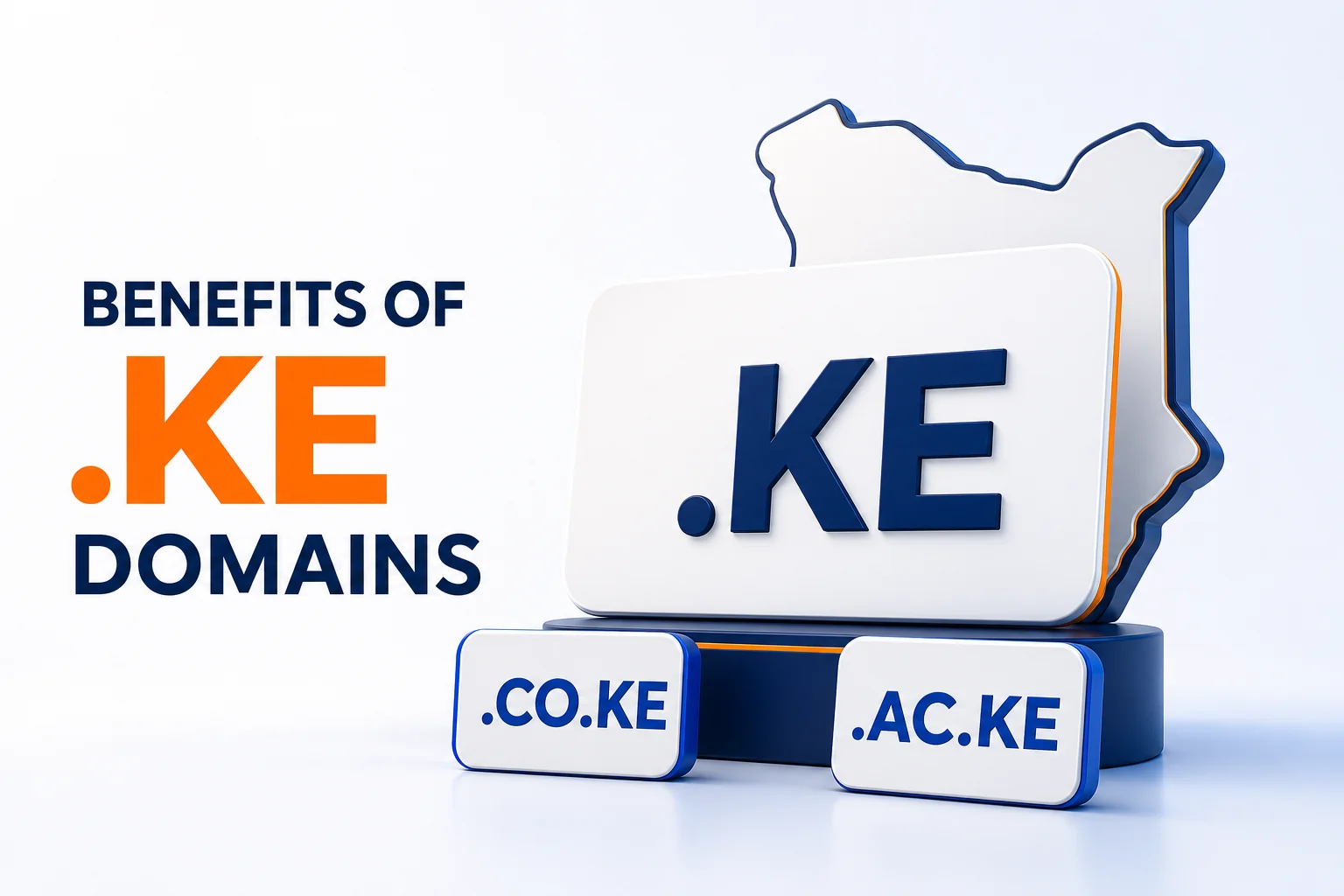
.ke is Kenya’s country-code top-level domain. You can register a name directly beneath it, such as yourname.ke, or beneath a category such as .co.ke, giving you yourname.co.ke.
KeNIC defines the first as a second-level registration and the second as a third-level registration. Both belong to the Kenyan domain namespace. .co.ke is not a separate country-code top-level domain.
The category also gives the address a purpose: KeNIC positions .co.ke for retail, ecommerce and other commercial ventures. Direct .ke has no equivalent category label, so it can suit a business, personal brand or another project with a Kenyan identity.
Direct .ke is an established option. KeNIC launched it in May 2017; it is no longer a newly introduced alternative.
Neither ending appears in KeNIC’s list of extensions requiring institutional supporting documents, which covers .go.ke, .sc.ke and .ac.ke. You still need accurate registrant details, and your registrar may request verification. The commercial meaning of .co.ke should not be confused with those institutional approval requirements.
Compare the whole name, not only the ending
With the same name before the suffix, direct .ke saves three characters: the co. in .co.ke. That saving carries through to an email address too.
For example, the illustrative pair yourname.co.ke and yourname.ke would give you addresses such as [email protected] and [email protected]. These are examples, not availability results.
The shorter ending becomes more useful when it lets you keep your exact brand name. If the matching .co.ke is taken, an available direct .ke could avoid adding an unnecessary word or hyphen. But a long, awkward name does not become easy to remember simply because it ends in .ke.
Compare both complete spellings through our domain search before settling on one. A name being taken under one ending does not tell you whether it is available under the other. KeNIC’s registration policy also excludes reserved and restricted names, so not every unused-looking address is registrable.
A useful naming test is whether someone can write the full address correctly after hearing it once. Include the ending when you test it. If the difficulty lies in the brand spelling, our name-selection guide can help you solve that before buying an extension.
Registration price is only the first payment
Our published rates currently make .co.ke the less expensive option for both registration and renewal. Compare the two payments separately:
| Domain | First-year registration | Renewal per year |
|---|---|---|
.co.ke | 299.00 KES | Kshs 1,500.00 |
Direct .ke | 2999.00 KES | Kshs 3,000.00 |
The first-year price can include a promotion. Our current .co.ke offer is available once per customer for one qualifying item per order. The renewal column is the continuing cost to budget for; a registration discount does not establish what you will pay every year. Confirm your eligibility and the final total for your exact name and term before paying.
For a three-year budget paid year by year, add the first-year registration price to two annual renewals at the quoted rate. Compare that with the total quoted for a three-year registration paid upfront, if available. These are comparisons at today’s prices, rather than promises that future rates cannot change. If you intend to own both names, include both sets of renewals.
For a small shop or service business, the extra spend on direct .ke should buy a concrete naming benefit: your exact brand, less clutter in the address, or a shorter name you intend to use prominently. Paying more solely because the ending looks newer gives you no demonstrated business return.
Neither ending buys better Kenyan rankings
Google describes country-code domains as a strong country-targeting signal. Both options keep your address within Kenya’s .ke namespace.
That guidance does not establish that direct .ke ranks above .co.ke, or that .co.ke must rank higher because it has a longer history. There is no basis here for paying more or changing domains to obtain a supposed extension advantage.
Google also considers other signals, including local addresses, phone numbers, language and currency. Those help establish who your pages serve. The suffix alone cannot explain your services, answer customer questions or supply those business details.
Visitors outside Kenya can access either address. Country targeting concerns the audience your site signals, not a geographic access restriction. If the business is primarily international, the more relevant decision may be .co.ke versus .com, rather than which Kenyan ending is shorter.
Keep an established address unless the change earns its cost
If customers already know your .co.ke, the matching .ke can be worth securing without replacing your main address. That preserves continuity while giving you another name to use in a campaign or future rebrand.
A full switch needs a stronger reason than saving three characters. Your old domain may appear on invoices, printed material, customer records, partner websites and staff email accounts. Moving means deciding how each of those references will continue to reach you.
For search, Google treats a domain change as a site move. Its guidance calls for mapping old URLs to the corresponding new ones, setting up redirects and monitoring the move. Rankings can fluctuate while Google processes the change.
That makes a move easier to justify during a genuine rebrand, or when the current address is confusing, than simply because another ending looks cleaner. If your existing name works and you have no wider reason to change it, we recommend keeping it as the primary address.
Owning both means managing two different domains
Registering yourname.co.ke does not include yourname.ke. They are separate registrations, with separate renewal obligations. Owning both can reduce confusion around those two versions of your name, but it does not cover every possible variation or settle trademark rights.
For one business website, one domain can remain the primary address while the other redirects visitors to it. There is no need to maintain two copies of the same website just because you own two names.
Email needs its own decision. A website redirect does not make mail sent to [email protected] arrive at [email protected]. Receiving messages at both addresses requires a suitable email configuration, such as aliases or forwarding supported by your email service.
Keeping both is most useful when the alternative is close enough that customers might use it, or when you have a clear plan for the second address. It also means maintaining the second domain and any services attached to it, even if you rarely promote it.
Before you register, settle these three details
Your choice is ready when you can answer three questions:
- Full spelling: Which complete address best preserves your brand and is easiest to communicate?
- Continuing budget: Can you cover the renewal cost of every domain you intend to keep?
- Registered owner: Will the domain be registered in your name or your business’s name, with contact details you control?
KeNIC advises that a domain registered for a paying client should normally use that client’s name. If a designer handles the purchase, agree on the registrant details and account access before they register it.
You can then check your preferred spelling and its alternative in our domain search, and register the address you intend to use with us.