 Domain SearchInstantly check and register your preferred domain name
 Web Hosting
 cPanel HostingHosting powered by cPanel (Most user friendly)
 WordPress HostingHost your WordPress website with fast, secure, and affordable WordPress hosting in Kenya.
 KE Domains
 Reseller HostingStart your own hosting business without tech hustles
 Windows HostingOptimized for Windows-based applications and sites.
 Free Domain
 Affiliate ProgramEarn commissions by referring customers to our platforms
 Free HostingTest our SSD Hosting for free, for life (1GB storage)
 Domain TransferMove your domain to us with zero downtime and full control
 All DomainsBrowse and register domain extensions from around the world
 .Com Domain
 WhoisLook up domain ownership, expiry dates, and registrar information
 VPS Hosting
 Managed VPSNon techy? Opt for fully managed VPS server
 Dedicated ServersEnjoy unmatched power and control with your own physical server.
 Website Builder
 Online Store BuilderLaunch a professional e-commerce store without writing code.
 Web Design ServiceGet a custom-designed website tailored to your brand and goals. From just KES 15,600
 BlogRead our guides on web hosting, online business, digital marketing, and more
 SupportOur support guides cover everything you need to know about our services
 ContactContact us via chat or email
A VPS sits between shared hosting and a full dedicated server.
It gives you your own slice of a physical server with dedicated resources like CPU, RAM, and storage.
This setup delivers better speed, stronger uptime, and full control over how your hosting works.
You stay isolated from other users, so one neighbor’s traffic spike won’t slow you down.
Many people start on shared hosting and feel the limits as their site grows. That’s when a VPS often makes perfect sense.
Through this guide, you’ll learn when to use a VPS. I’ll walk through five practical scenarios where upgrading delivers results. You’ll also learn how to get started smoothly.
What are common VPS uses?
Let’s look at the five most common situations where a VPS becomes the smart choice.
1) Hosting High-Traffic Websites
Shared hosting works fine for small sites. But once traffic climbs, say 5,000 to 10,000+ visitors daily, you start noticing slowdowns during peaks.
Your pages load more slowly. Customers abandon carts. Search rankings can slip.
A VPS fixes this by giving you dedicated resources that don’t get shared with others.
Why it fits e-commerce so well:
- Handles flash sales, holidays, and sudden traffic surges without crashing.
- Supports fast database queries, SSL certificates, and PCI compliance for secure payments.
- Improves page load times, which directly boosts conversions and SEO.
Other website uses include content-heavy blogs, WordPress or Drupal sites, portfolios, and membership platforms that have outgrown shared plans.
Top benefits:
- Root access to install caching tools like Redis or optimize with NGINX.
- Easy scaling, add more RAM or CPU when needed.
- Many choose managed VPS, so experts handle security updates and maintenance.
If your site regularly feels slow or you worry about uptime during busy periods, this is one of the clearest signs it’s time for a VPS.
2) Game Server Hosting
Running your own game server is one of the most popular non-website uses for a VPS.

Be it a private Minecraft world for friends or a full Rust community server, a VPS gives you the performance and control that public hosts often lack.
Popular games people host:
- Minecraft (especially modded)
- Rust
- ARK: Survival Evolved
- CS:GO / Counter-Strike
- Palworld, Terraria, and more
Why a VPS beats shared or public options:
- Dedicated CPU and RAM handle more players smoothly.
- Low-latency locations reduce lag.
- Full control over mods, plugins, settings, and backups.
- Better DDoS protection critical for gaming servers.
For example, a modded Minecraft server with 30–50 players needs solid RAM (often 8GB+) and fast storage. A good VPS keeps everything running 24/7 without your home PC staying on.
Look for plans with high clock speeds, plenty of bandwidth, and strong DDoS mitigation. Gaming-optimized VPS options exist from many providers.
3) Development and Testing of Code and Applications
Developers love VPS for safe, realistic testing environments. Instead of risking your local machine or production server, you spin up an isolated space that mirrors real conditions.
Common uses:
- Building and testing web apps or mobile backends.
- Running CI/CD pipelines.
- Experimenting with different OS versions, databases, or tools.
- A/B testing new features safely.
- Learning sysadmin skills or practicing deployments.
You get full root access, so you can break things, reinstall software, and try risky configurations without consequences.
Teams use VPS to create consistent environments across members, no matter where they work.
Example: You’re developing a new feature that needs specific database settings. On your laptop, it works, but production behaves differently. A VPS lets you replicate the exact production stack and catch issues early.
It’s also cost-effective to spin up a strong server for heavy tests (like machine learning or video processing), then scale down when done.
Get information on the best control panel for VPS hosting
4) API Flexibility (Hosting APIs and Backends)
Modern apps need strong backends. A VPS gives you the freedom to run custom APIs, web services, and application backends how you want.
You can install any tech stack, such as Node.js, Python, Java, PHP, databases like MySQL or MongoDB, and tools for caching or monitoring. This beats the limitations of some Platform-as-a-Service options.
Why it works so well:
- Dedicated resources prevent performance issues from “noisy neighbors.”
- Easy to add load balancing, auto-scaling, or custom security.
- Handles variable traffic from mobile apps, microservices, or internal tools.
A VPS lets you run the full backend reliably and scale it as users grow. Many automation scripts, bots, and business tools also run best here.
5) Access to Multiple Domains and Many IPs
A VPS is best when you need to host several websites or require extra IP addresses.
Multiple domains: Use virtual hosts in Apache or NGINX to run many sites on one server. Perfect for agencies, developers with client projects, or personal portfolios.
Multiple IPs: Add extra IPv4 addresses (usually as add-ons). This helps with:
- Dedicated IPs for SSL in older setups.
- Separating email reputation.
- Geo-targeting or compliance needs.
- Better isolation between services.
You can even run different services on specific ports or IPs for a cleaner organization.
For instance, an agency managing 10 client sites can host them all efficiently on one well-specced VPS while keeping configurations separate.
Check our guide on the best VPS hosting with WHMCS support
How to Get Started with VPS Hosting
1) Evaluate your current and future needs
Look at your current traffic, the type of sites or apps you’re running, and where you expect to be in 12 months. If you’re hitting shared hosting limits now, assume your needs will grow, and plan accordingly.
2) Choose a reliable provider with strong support and scalability
Not all VPS providers are equal. You want one that offers consistent uptime, responsive support, solid security, and the ability to scale your plan as your needs grow.
This is what we offer at Truehost. Our VPS Hosting plans are built for businesses and developers who need power without the complexity.
You get dedicated resources, root access, and expert support without having to manage every server detail yourself.
3) Choose between managed and unmanaged VPS
- Managed VPS: the provider handles server updates, security patches, and monitoring. Best if you want to focus on your website or app, not server maintenance.
- Unmanaged VPS: you have full control and responsibility. Best if you have strong technical skills and want complete customization.
For most businesses and growing websites, managed VPS is the smarter choice. It removes the server administration burden so you can focus on the important work.
4) Set up your virtual server
Once you’ve chosen your plan, install your preferred OS (Ubuntu, CentOS, or Debian are popular choices), set up your web server software (NGINX or Apache), configure your databases, and deploy your sites or applications.
At Truehost, our VPS Hosting plans are designed to be powerful enough for serious workloads and simple to use.
Get a detailed guide on what VPS hosting is used for.
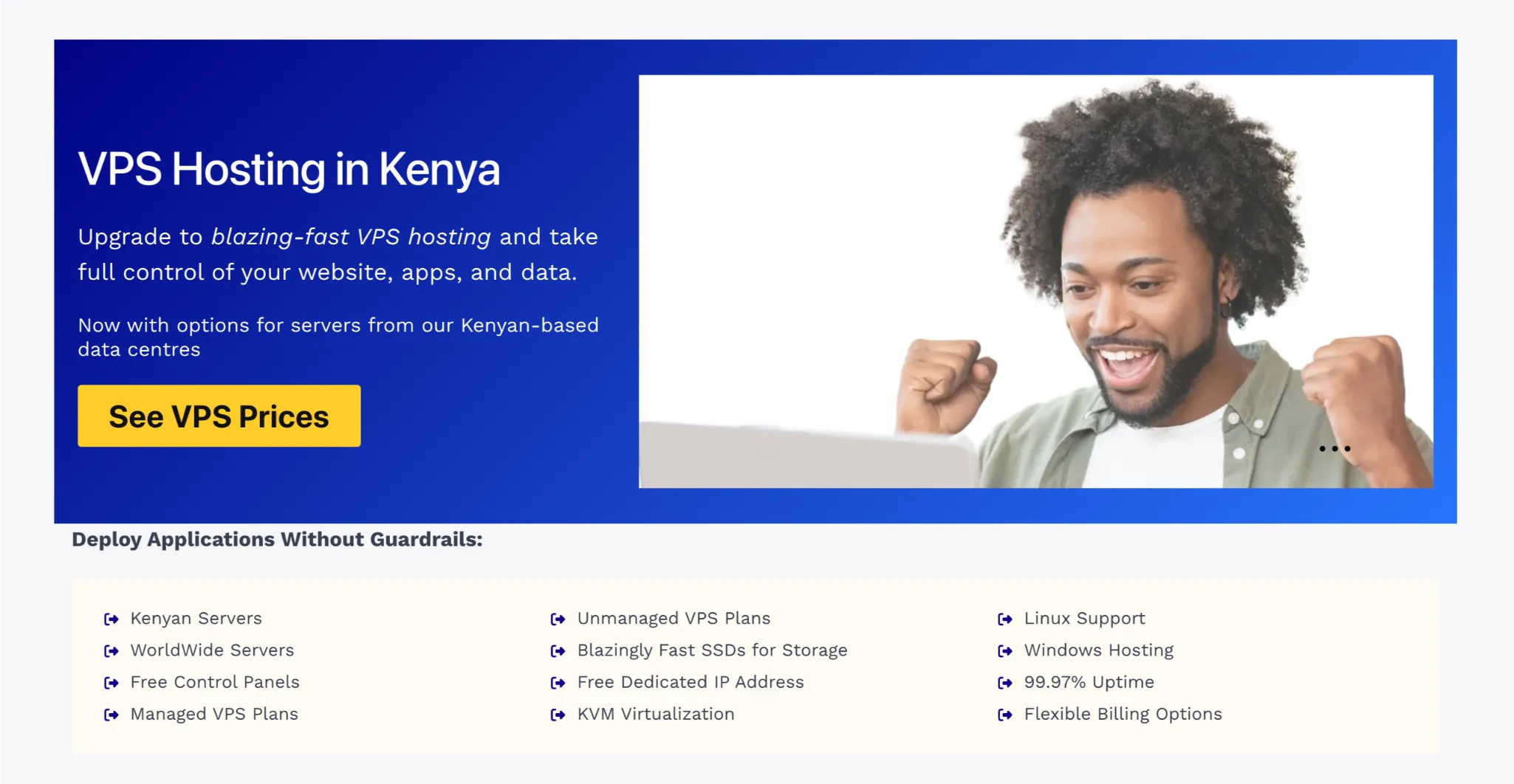
We have Flexible plans, local payment support (M-PESA included), and a team that responds when you need help.
Check out our VPS plans today and find the one that fits where you’re headed.